Metal roof or shingles for a central Pennsylvania home: how to decide
Ribbed metal versus asphalt shingles for a house in Clinton County: snow shedding, lifespan, the fastener question, what each needs from the roof pitch, and what actually moves the cost either way.
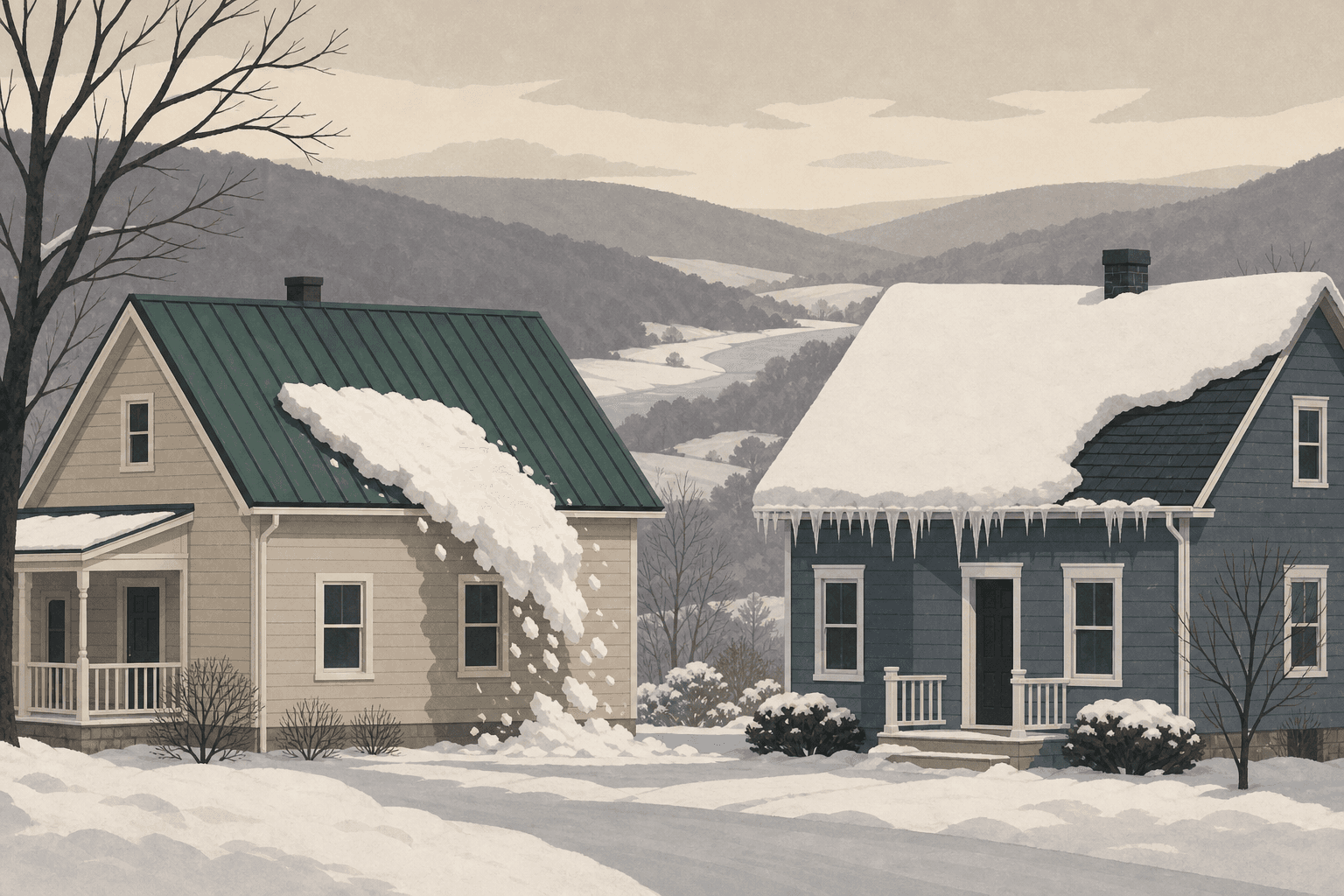
Both roofs are common in central Pennsylvania: shingles on houses, ribbed steel on barns and outbuildings, and metal showing up on more houses each year. The right one for a given house comes down to snow, pitch, what is already up there, and how long the owner plans to stay. Price matters, but it is rarely what settles it.
Key facts
- Metal sheds snow and shingles hold it, and in a valley with real winters that one difference is behind most of the ice dams, gutter damage, and roof-weight worries.
- A good asphalt roof here is a twenty to thirty year roof. A painted steel roof is expected to outlast it by decades, with the fasteners as the maintenance item.
- Shingles need pitch. Below about 2:12 they are not an option, and between 2:12 and 4:12 they need extra underlayment. Metal panels are made for low slopes.
- Metal is light enough that it can often go over one existing layer of shingles, which avoids a tear-off. Check the local code and the panel manufacturer first.
- The noise complaint is mostly a myth on a house with solid decking and underlayment under the panels.
Snow and ice
Snow slides off metal. That is the biggest practical difference in this climate. A shingle roof holds its snow load until it melts, and the melting is what causes ice dams: heat from the house melts the underside of the snow, the water runs to the cold eave, and it refreezes into a ridge that backs water up under the shingles. A metal roof dumps the snow before that cycle gets going, so ice dams are far less common, though they still form at valleys and on sections that shade the rest.
Shedding snow has its own consequences. A slab coming off a metal roof lands on whatever is below, so snow guards go above doorways, walkways, the meter, and the heat pump. Gutters on a metal roof take a beating from sliding ice unless they are set slightly below the drip line.
Lifespan and maintenance
Asphalt shingles wear out. Granules wash off, the mat gets brittle, and in twenty to thirty years the roof is done regardless of how it was cared for. A painted ribbed steel roof does not wear out the same way. The paint chalks over decades and the panels hold up, so the roof's life is mostly a question of the fasteners and the trim.
That is where the maintenance is. Exposed-fastener metal panels are held down with screws that have a rubber washer under the head. The washers age, the screws back out a thread or two as the panels expand and contract, and eventually water finds the hole. Replacing gasketed screws on a schedule is normal ownership of a metal roof, and the metal roof leak article walks through the other places they leak. Standing seam metal hides the fasteners under the seams and removes most of that maintenance, at a higher cost.
Shingle maintenance is simpler and less frequent, mostly keeping gutters clear and replacing the occasional blown-off tab. The trade is that the whole roof gets replaced far sooner.
Pitch and what is already on the roof
Roof pitch limits the choice. Shingles need at least a 2:12 slope, and manufacturers require a full ice and water membrane under them between 2:12 and 4:12. Below 2:12, shingles are out and metal or a membrane roof is the answer. That is why mobile home roof-overs end up in metal: the original roof is nearly flat, and the roof-over guide covers how the new pitch gets built.
Weight goes the other way. Metal panels weigh a fraction of what shingles do, so a metal roof can often be installed over a single layer of shingles on furring strips or a synthetic underlayment. That avoids the tear-off, the dumpster, and a house open to the weather. A second layer of shingles over a first is also allowed in many places, but it adds weight, hides deck problems, and shortens the new roof's life. A roof with two layers already has to come off whichever way you go.
Comparison
| Factor | Asphalt shingles | Ribbed metal panels |
|---|---|---|
| Snow | Holds it; ice dams form at the eave | Sheds it; needs snow guards over walkways |
| Expected life | Twenty to thirty years | Several decades; paint and fasteners age first |
| Maintenance | Gutters, occasional tab replacement | Gasketed screws replaced on a schedule |
| Minimum pitch | 2:12 with extra underlayment; 4:12 standard | Low slopes, including roof-overs |
| Weight | Heavy; two layers is the limit | Light; can go over one layer of shingles |
| Noise in rain | Quiet | Similar on solid decking; louder over open purlins |
| Hail and wind | Impact damage shows as lost granules | Cosmetic dents; panels hold in wind when screwed right |
| Repair | Easy to patch a small area | Panels replace whole; leaks are fastener work |
What moves the cost
Neither material has a fixed price, and any number quoted without seeing the roof is a guess. What moves the number is the same for both: the roof's square footage and pitch, how many valleys, dormers, chimneys, and vents interrupt it, whether the old roof comes off, and the condition of the decking underneath. On metal, panel gauge, paint grade, and exposed fastener versus standing seam are the big swings. On shingles, the grade of shingle and the ice and water coverage are.
Insurance is a separate question. Some carriers treat metal differently in premiums or in how they settle hail claims, and the roof leak insurance article covers how a roof claim works. Ask the carrier before choosing on that basis alone.
How to decide
A few questions settle most cases:
- How long do you plan to own the house? A shingle roof is the cheaper roof for the next fifteen years. Past that, the metal roof is the one you did not have to replace.
- What is the pitch? Low slope answers the question for you.
- How many layers are up there? Two layers means a tear-off either way.
- Do you have ice dam damage now? Stains at the top of exterior walls after a cold snap are a vote for metal, and for attic air sealing whichever roof you choose.
- What is below the eaves? Snow guards are part of a metal roof estimate, not an add-on later.
Either roof is a permitted job in most Clinton County municipalities when the decking is exposed or the structure changes; the permit article covers who to ask. The metal roof repair page describes the repair side, which is where an existing metal roof usually lands before it ever needs replacing.
Common questions
Is a metal roof louder in the rain?
On a house, no. The decking, underlayment, and attic insulation between you and the panels absorb it. The drumming people remember is metal screwed to open purlins on a barn.
Can I put metal over my existing shingles?
Often, over a single layer, on furring strips or an approved underlayment. The decking has to be sound, and the municipality and the panel manufacturer both have a say.
Do metal roofs attract lightning?
No more than any other roof. Lightning strikes the tallest thing in the area regardless of material, and a metal roof is not combustible if it does.
Will a metal roof lower my cooling bills?
A light colored or reflective metal roof reflects more summer heat than dark shingles do. In this climate the winter side of the ledger matters more, and that comes down to attic insulation rather than the roof surface.
If the roof is leaking now, the first question is whether it needs a repair or a replacement, and that is a ladder-and-an-hour question rather than a phone one. Request a look here.
Have a project like this in Lock Haven or Clinton County?