The five places a metal roof actually starts leaking
The five parts of a metal roof that actually fail, how a hose test finds the real entry point, and why the stained ceiling underneath belongs to the same repair.
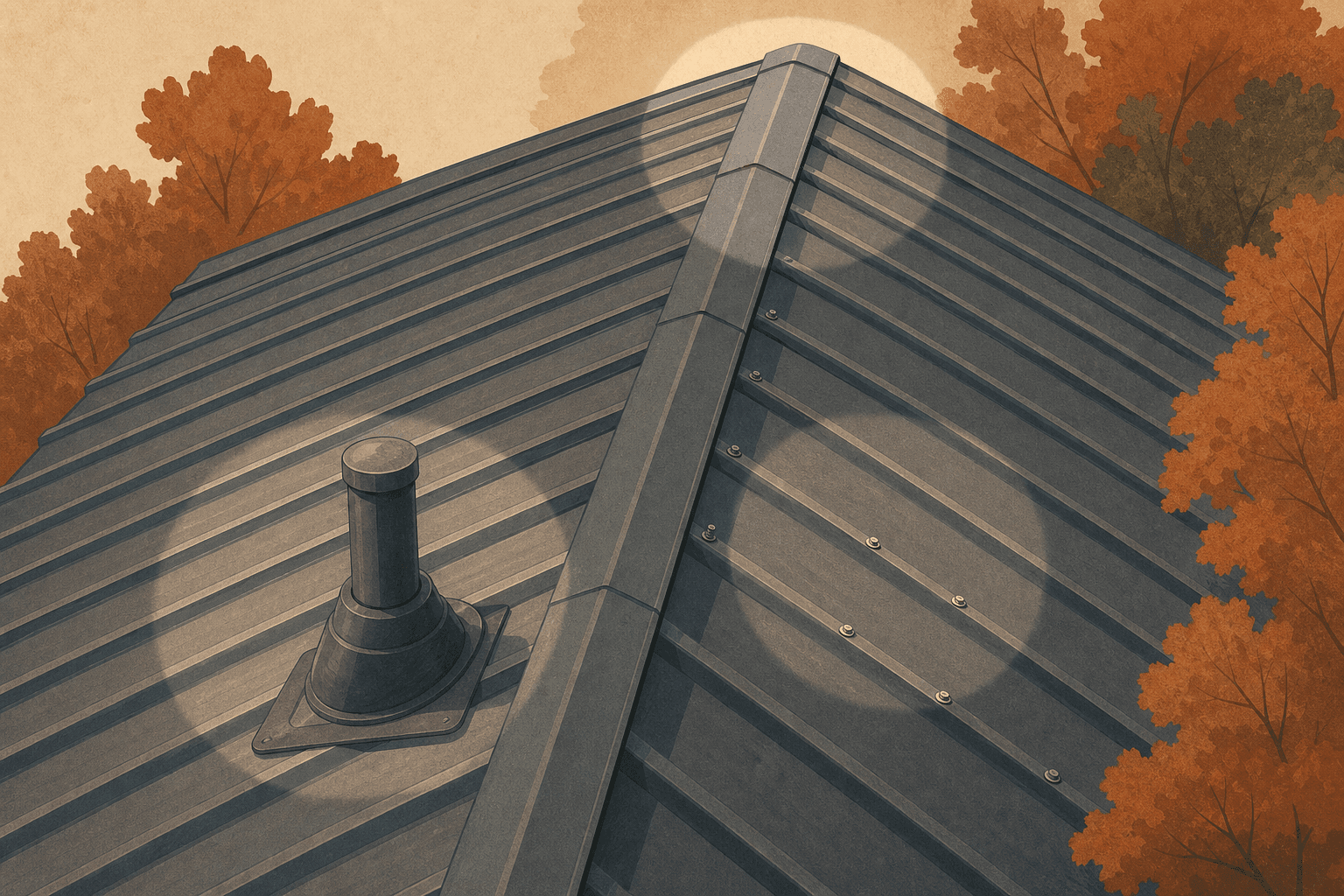
Metal roofs almost never leak through the middle of a panel. They leak at the five things fastened through them or sealed onto them: the screws, the ridge cap, the rubber boots at vent pipes, the seams where panels overlap, and the flashing where the roof meets a chimney or wall. Nearly every leak I get called out for around Clinton County is on that list.
- The rubber washer under a gasketed screw wears out long before the steel panel above it does.
- Water can enter at the ridge and stain a ceiling several feet away, so the stain is rarely under the hole.
- A hose test, with somebody watching from inside, is how I confirm the source before quoting.
- I handle metal roof leak repair and the stained ceiling underneath as one job.
The five failure points, in the order I check them
Gasketed screws that have backed out
On an exposed-fastener roof, the kind where you see rows of screw heads, the seal is the rubber washer under each metal cap.
The panel moves. It grows in the sun and shrinks overnight, every day, for the life of the roof. Enough cycles and the screws work loose, the hole wallows out oval, or the washer flattens and quits pressing on the metal. Water runs down the shank onto the underside of the panel, where you will never spot it from a ladder.
Ridge-cap sealant that has gone chalky
At the ridge, the sealant is what fails. The ridge is the peak where two runs of panel meet, with a cap over them and foam closures or sealant filling the gaps under the ribs. That sealant hardens, shrinks back, and opens a gap you cannot see from the ground.
Wind-driven rain gets pushed up under the cap. So does meltwater, when a snow load sits there a week and refreezes overnight. That is what I found on the Loganton repair.
Vent-pipe boots split by the sun
The rubber is what dies on a vent boot, the cone with a metal flange sealed to the panel around a plumbing vent. Sun works on that rubber from the day it goes on, and the cone cracks at its base, where it flexes hardest against the pipe.
A split boot drops water straight down the pipe into the ceiling below. That makes it the easiest one to spot from inside. On the Loganton roof that boot got replaced, not sealed over.
Panel laps, where two sheets overlap
End laps are where I find trouble. Panels overlap along a rib at the sides, and end to end where a run gets spliced partway up the slope. Side laps are usually fine if the ribs were seated right.
Especially on a shallow pitch, water sitting in an end lap gets drawn uphill between the two sheets by capillary action, a tight gap pulling water against gravity. Butyl tape, the sticky strip that seals that joint, does not always stop it. Skip the tape at install and the lap looks fine in a light rain and leaks in a long one.
Flashing where the roof meets something else
A lot of what I find here is a bead of caulk doing a job bent metal was supposed to do. Flashing is that bent metal. It belongs anywhere the roof changes direction or something comes through: chimneys, sidewalls, valleys, skylights, where a porch roof dies into the house.
Caulk over a correct flashing detail is normal maintenance. Caulk standing in for the flashing fails within a few seasons.
| Failure point | How it looks inside | Repair |
|---|---|---|
| Gasketed screws | Scattered damp spots, worse in driving rain | Replace that row with larger-diameter screws |
| Ridge cap | Staining near the peak, or well down the slope | Clean and reseal the joints, replace failed closures |
| Vent-pipe boot | A stain directly under a bathroom or kitchen vent | New boot, sealed and fastened to the panel |
| Panel end lap | Wet only in heavy or sustained rain | Open the lap, clean it, reseal with butyl |
| Chimney or wall flashing | Staining along one wall or a room corner | Rework or reseal the flashing |
How I find where the water gets in
I find it with a garden hose and a spotter: somebody inside with a light, under the stain. The stain is not the hole. It marks where water finally ran out of somewhere to go.
Water can enter at a ridge seam, run along the underside of a panel and then a rafter for several feet, and drop through the insulation somewhere else.
So the test goes in order. I start at the eave, the low edge of the roof, wet one zone at a time, wait, then move up the slope. Starting at the ridge is the classic mistake. Do that and the whole roof below is wet and you have learned nothing. People are surprised how long I will run water on one section before moving the hose.
The Loganton metal roof repair went that way. Safe access first, then the hose test with a spotter inside. Only then did anything get fixed: ridge-cap joints resealed, suspect screws swapped out, a new vent-pipe boot, sealant touched up at the chimney flashing. That job is out in Loganton, 25 minutes south of Lock Haven, where I have six finished jobs.
Why the ceiling belongs to the same job
Sealing the roof does nothing for the ceiling under it. Water coming through the roof lands on insulation and drywall, and stopping the leak dries neither one. A brown ring already set into the ceiling paint stays too. Paint over that ring without a stain-blocking primer and it bleeds back through inside a month.
This is where people get stranded. The roofer stops at the roofline and the drywall guy will not climb onto metal. On the Loganton job I opened the cavity, replaced the affected insulation, treated the staining, then patched, primed, and repainted.
If the leak came out of a storm and you are filing a claim, I write the scope line by line with overhead and profit, the markup that pays for running the business. That is what insurance claim repairs means here. Whether the damage is covered is a question for your carrier.
When a repair is not the honest answer
Some roofs are past repairing. If the panels are rusted through in the middle, or the structure underneath has gone soft, resealing buys a season. In 2024 I framed custom trusses over a Loganton mobile home whose original roof had failed, then ran ribbed metal over a Tri-Flex-wrapped deck. That is a roof-over rather than a repair, and you will hear which one you have before you get a number.
Common questions
How do I tell whether my screws need replacing or just tightening?
Replacing, almost always. If you can see daylight between the washer and the panel, or a screw head sitting higher than its neighbors, that seal is finished. Tightening drives a hardened washer into a hole that already wore oval, and it will be loose again by next summer. Replacement screws go a size larger to grab fresh metal.
Why does the leak only show up in some storms?
Because most of these failures need help to leak. A ridge joint or an end lap sheds a straight vertical rain, then lets water in the moment wind drives that rain sideways at the seam. Snow is the other one: a load that melts from underneath puts standing water where the roof was never meant to hold it.
Can I run sealant over the screw heads myself?
You can, and I would rather you did not. Smearing sealant across a row of fasteners hides which screws actually failed, so whoever comes next has to scrape it off before diagnosing anything. It also traps moisture against the panel, where the metal rusts. Failed fasteners are a replacement item.
Do you fix the ceiling, or do I need a second contractor?
I do both, and I think it is the only sensible way to sell this work. The roof gets repaired at the source, then the cavity gets opened, the wet insulation comes out, and the drywall gets patched, primed, and painted. I am Thomas Darby, a registered Pennsylvania home improvement contractor (PA HIC #PA2199962), and my labor carries a 1-year workmanship warranty.
If there is a stain on your ceiling and a metal roof over it, send photos through the quote form and I will get you a written number for metal roof leak repair.
Have a project like this in Lock Haven or Clinton County?