Mobile home roof-over or full replacement: how to tell which one you need
How to tell whether a mobile home roof in Clinton County needs a truss roof-over or a tear-off, and what my 2024 Loganton roof-over in ribbed metal actually involved.
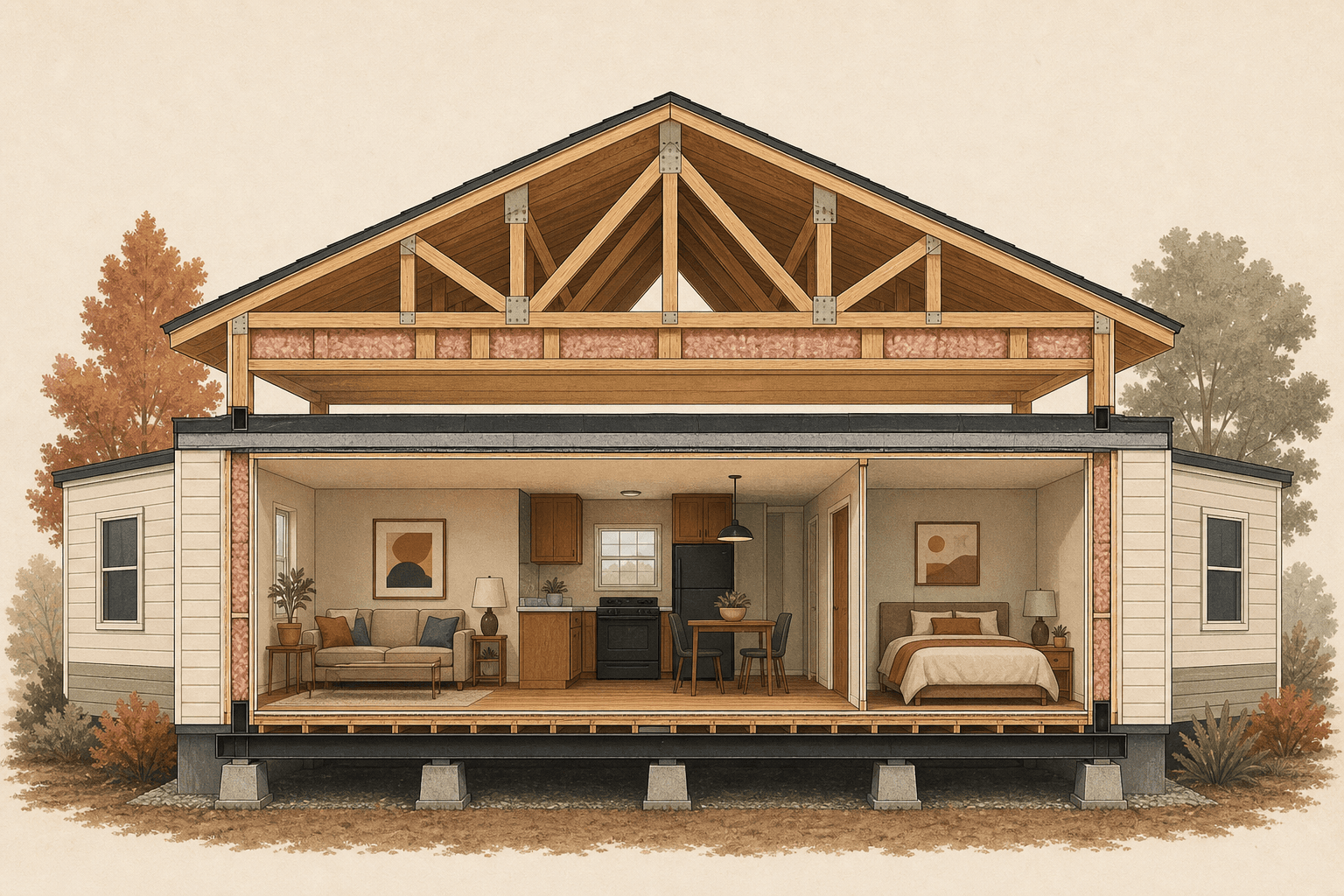
A roof-over is the right call when the roof surface on your mobile home has failed but the structure under it is dry and sound. Full replacement, or tear-off, is the call when it is not. If water has sat long enough to rot the decking, the wood under the surface, or soak the ceiling insulation, building over the top seals that wet in. You pay twice.
Key facts
- A roof-over is a new pitched roof structure built over the existing roof, not a coating.
- New bearing points take the new weight, because the factory roof structure usually cannot.
- Rotted decking or wet ceiling insulation pushes the job toward tear-off.
- My 2024 Loganton roof-over: trusses built on site, plywood deck, Tri-Flex underlayment, ribbed metal.
- Written quote within 48 hours, deposit only when you say go, one year on my workmanship.
What a roof-over actually is
A roof-over is a second roof with real pitch, framed and set over the top of the original. New bearing points get set so the new weight lands where the home can carry it, trusses go up, the deck gets sheathed and wrapped, and metal goes over all of it. The old roof stays underneath doing nothing, which is fine, because it quit working a while back.
Most mobile homes left the factory with a flat or barely pitched roof. Older ones have a shallow arched metal roof, newer ones a low-slope shingled roof over light trusses, the frames that hold a roof up. Either way water does not leave in a hurry. It works toward the seams and vent openings. In the valleys it sits under wet snow for a week.
When a roof-over is the right call
A roof-over is the right call when the damage stopped at the surface. I check a few things first.
The walls have to be plumb enough, meaning straight up and down, and solid enough to take new bearing points. The ceiling has to be dry, which I check from inside by feeling the insulation instead of guessing from the roof. And the leaking has to be a surface problem: chronic seam and fastener trouble on a roof that never had enough pitch.
That last one is the classic case: somebody has been coating the same flat roof every couple of years and it keeps coming back.
The other reason people go this way is heat. A new deck above the old roof creates a cavity that can take insulation the factory never put up there, vented like a real attic. On a home with an arched metal roof and a thin batt of insulation above the ceiling panels, that cavity changes how the home holds temperature in January. I would not build a roof-over for heat alone, but it is worth weighing.
When a roof-over is the wrong call
A roof-over is the wrong call when anything underneath is wet or broken. A new roof hides whatever you do not fix first.
If the decking is soft, fasteners have nothing to bite into. Wet insulation above the ceiling stays wet under a new roof. It works on the ceiling panels and the boards at the top of the walls for years while you think the problem is handled.
A sag in the roof line is structural, and covering it does not change where the load goes. If somebody already put a roof-over on this home, the old one comes off first. Same if the original metal is coated so many times the seams are buried in mastic sealer.
If the floor has soft spots and the frame is settling, a new roof is money spent on the healthiest part of the home. Those problems belong in a wider conversation about mobile home repair, and sometimes the answer is the floor this year and the roof next.
Roof-over vs tear-off compared
| Factor | Roof-over | Tear-off and rebuild |
|---|---|---|
| The old roof | Stays in place under the new roof | Comes off down to the framing |
| Structure | New bearing points carry a new truss roof | Framing repaired or replaced, then re-decked |
| Home open to weather | Mostly at the edges, inside stays covered | Open once the old roof is off, so weather drives the schedule |
| What you learn about the deck | Only what shows from the edges and inside | All of it, in front of you |
| Insulation | You can add an insulated cavity above the ceiling | You replace whatever is up there now |
| Pitch | You pick it, and a steeper roof sheds snow | Usually rebuilt near the original slope |
| Best when | The surface failed and the structure is dry | Decking is rotted or the roof line sags |
| Worst when | Wet material gets sealed in underneath | Nothing structural is actually wrong |
What a truss roof-over involves
The job people ask about is a Loganton mobile home from 2024. The original roof had failed. I assessed it and set new bearing points so a full gabled roof, a real peak, could land on the existing structure without leaning on parts that could not take it.
Then I framed the trusses on site. Framing on site matters on a mobile home, because factory trusses come in standard spans and your home is whatever width the plant built it. The homeowner wanted them oversized for more pitch and strength than I would have specified, so that is what I built, braced, and set.
The new deck went on in plywood, then Tri-Flex synthetic underlayment across the whole thing. Underlayment is your water layer while the roof is open, and it keeps working after the panels go down. Ribbed metal went over top in green. Photos and the full step list are on the case study.
What moves the price
Footprint moves the price first, since a double wide is a much bigger roof than a single. Pitch is next, because steeper adds truss material and metal. Then how the new bearing points get built, from posts and footings to a beam, depending on what the walls and frame can carry. Closing in the gable ends, overhang detail, and gutters follow from there.
If a storm started this, document the damage before anything gets touched. Coverage is your insurance carrier's call, and I stay out of that part. What I can do is write the scope line by line so it reads clearly for whoever reviews it. I am Thomas Darby, a registered Pennsylvania home improvement contractor (PA HIC #PA2199962) out of Lock Haven.
Common questions
Can I just coat my mobile home roof instead?
A coating buys time on a roof that is basically sound. As a stopgap there is nothing wrong with it. A coating cannot add pitch. If your roof leaks because water sits on it, a coating is a surface fix on a shape problem. You will be back up there in a few years. Coating layers also stack up and get harder to work over later.
Will a roof-over make my mobile home too heavy?
Not if the bearing points are built right. That is why they come before trusses. The factory roof structure on most manufactured homes was designed for its own weight and the local snow load, with nothing left over for a second roof. So the new structure does not rest on the old one. I set bearing points that carry the load down through walls, posts, or footings that can take it.
How can I tell if the decking is rotted before anything comes off?
You cannot always tell for certain, which is the honest answer. I look inside first, at the ceiling panels, the stains, and the insulation above them. Then I check the roof edges and fastener lines where water gets in. Soft spots underfoot and a sag in the roof line tell you plenty. Where it is still unclear, I open a small area and look.
My metal roof only leaks in one spot. Do I need a roof-over?
Probably not. In Loganton I traced a leak on a metal roof with a controlled hose test and a spotter inside. Then I resealed the ridge-cap joints, swapped suspect gasketed screws and a failed vent-pipe boot, and rebuilt the stained ceiling below. A boot is the rubber collar where a pipe comes through the roof. One bad boot is a repair. Metal roof repair is the cheaper conversation and I would rather have it.
Which of the two jobs your home needs takes an hour of my time and a ladder to answer. Read the mobile home roof-over page first, then request a quote.
Have a project like this in Lock Haven or Clinton County?