Does homeowners insurance cover roof leaks?
A plain-English guide to roof leak coverage: sudden versus gradual damage, how roof age and deductibles change the payout, why photographing damage before you tarp matters, what a contractor can and cannot do in a claim, and the policy sections that decide the outcome.
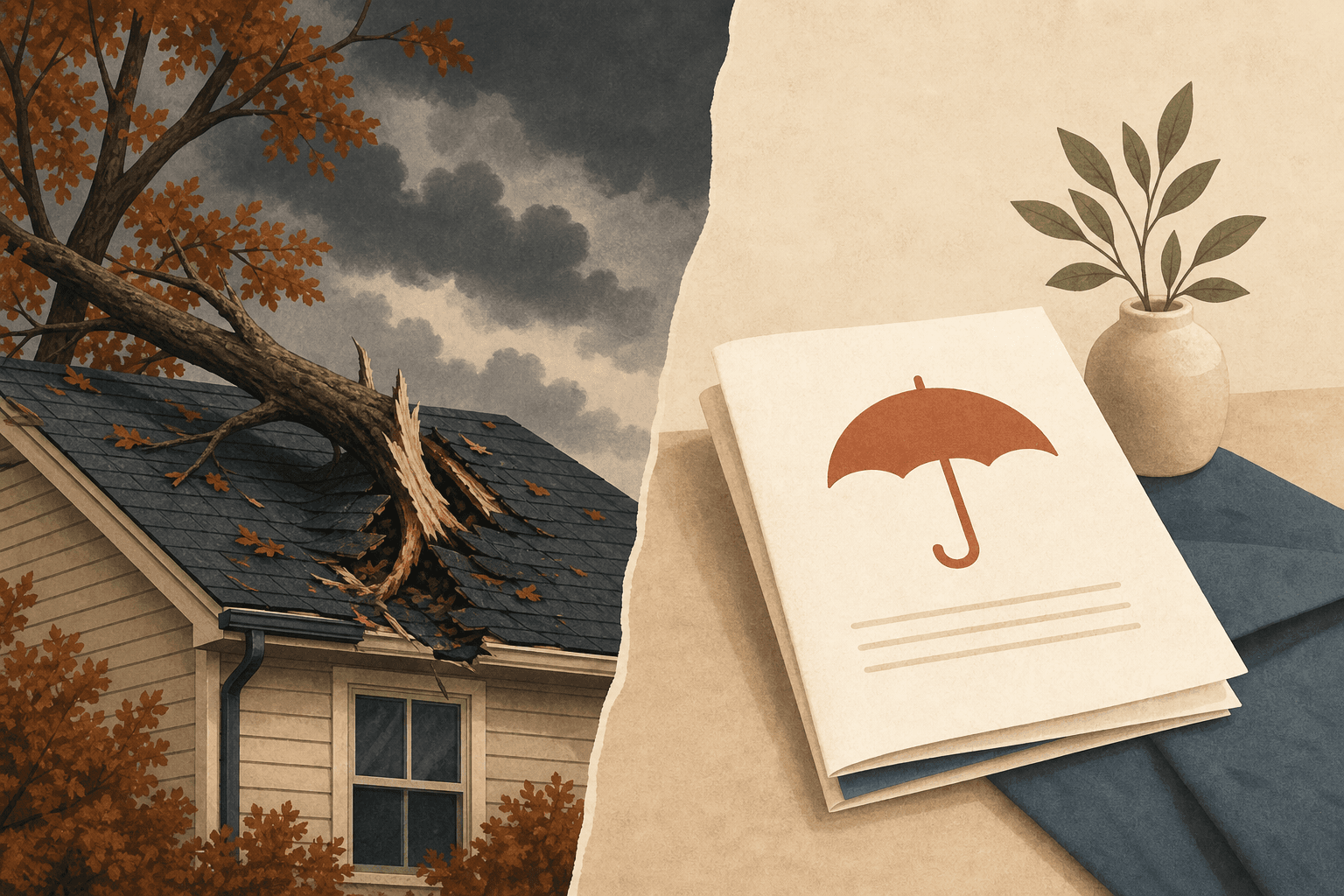
Does homeowners insurance cover roof leaks? Usually yes when the leak traces back to sudden accidental damage, like a wind-torn shingle or a limb through the deck. Usually no when it traces back to age, wear, or maintenance that got put off. The policy itself is the document that decides, and your declarations page, exclusions list, and deductible matter more than anyone's opinion of the roof.
- Sudden damage from a covered peril, like a windstorm or a falling tree, is what most policies pay for.
- Wear, rot, age, and faulty original workmanship are the causes most policies exclude.
- Interior damage under the leak is often handled differently from the roof itself.
- Photograph and video everything before you tarp, mop, or tear out anything.
- A contractor scopes and repairs the damage; the adjuster and the policy language decide coverage.
What does "sudden and accidental" actually mean?
Sudden and accidental means the damage happened at an identifiable moment from an outside force, rather than building up over seasons. A storm on a specific night that lifted shingles is sudden. A flashing joint that has been weeping since the roof went on is gradual, even if you first noticed the ceiling stain last week.
Adjusters look for evidence of when the damage started. Fresh tear lines in the shingle mat and bright wood at a break point to a date of loss. Old concentric staining and soft, dark sheathing point the other way, and that is the version most policies exclude.
Which roof leaks are usually covered and which usually are not?
Most policies sort roof leaks by cause rather than severity, so a small hole from a limb can be a covered loss while a badly leaking worn-out roof is not. The table shows how common situations tend to be treated, as orientation rather than a prediction.
| Situation | Usually treated as | What tends to drive the decision |
|---|---|---|
| Shingles blown off in a windstorm | Sudden accidental damage | Date of loss, wind reports, visible tear lines |
| Hail bruising on shingles | Varies by policy | Whether wind and hail are excluded or carry a separate deductible |
| Slow seep at old chimney flashing | Usually excluded as wear | Age of the flashing, long-term staining |
| Curled, brittle shingles at end of life | Usually excluded as wear and age | Roof age against expected service life |
| Ceiling and drywall soaked below a covered leak | Often covered when the roof loss is covered | The policy's ensuing loss language |
Two details change the math even on a clearly covered loss. One is your deductible, since some policies carry a separate percentage-based wind or hail deductible much larger than the standard one. The other is valuation: replacement cost pays to put back what was there, while actual cash value subtracts depreciation for the roof's age. Both are printed on your policy.
Why should you photograph the damage before you tarp it?
Because a tarp hides the evidence, and the adjuster may not stand on that roof for days. Most policies expect you to take reasonable emergency steps to prevent further damage, so tarping is the right call. Just document first.
Take wide shots showing the whole slope and enough of the house to prove which roof it is, then close shots of the break with a tape measure in the frame for scale. Get the inside too: the ceiling stain, the wet insulation, the soaked contents. Keep the damaged material instead of throwing it out, since a torn shingle or split flashing is physical evidence an adjuster can examine when cause is in question. Save receipts for tarps, fans, and any emergency visit, since those costs are often reimbursable under the same claim. If water is already in the house, what you do in the first 24 hours matters as much as the roof work.
Does the age of the roof change what gets paid?
Yes, often more than owners expect. Many carriers limit older roofs to actual cash value, exclude purely cosmetic damage, or ask for an inspection at renewal once a roof passes a certain age. None of that decides whether a storm caused your damage. It decides the number at the bottom of the estimate.
What is a contractor's role in a roof leak claim?
A contractor documents what is up there, writes a scope for the repair, and does the work. Interpreting your coverage is not part of that job. Done right, it means getting on the roof, photographing the conditions, describing the damage in factual terms, and writing a line-item scope an adjuster can compare against their own numbers.
When the contractor's number and the adjuster's number differ, the gap is usually about scope rather than honesty: missed items, code-required work, underlayment, or the count of squares. It helps to know how the two estimates get built before the spread frustrates you. Repair work tied to a claim, sometimes called insurance claim repairs, runs on the approved scope.
What a contractor should not do: promise your claim will be approved, offer to absorb your deductible, or tell you what your policy means. Home improvement contractors in Pennsylvania generally must register with the state and carry a PA HIC number, which is a registration rather than a license and says nothing about insurance expertise. Coverage questions belong with your carrier or a licensed public adjuster.
Where in the policy should you actually look?
Three places answer most roof leak questions. The declarations page lists your deductibles and whether the roof settles at replacement cost or actual cash value. The coverage section says whether the dwelling is written on open perils, which covers anything not specifically excluded, or named perils, which covers only what is listed. The exclusions section is where wear and tear, neglect, faulty workmanship, and rot appear, along with any carve-back that restores coverage for ensuing water damage.
Check the duties after loss language too, since it usually requires prompt notice and steps to protect the property. For what happens once you call it in, see how a water damage claim typically moves in Pennsylvania. And to say it plainly: this is general information, not insurance advice. Only your policy and your carrier can tell you what is covered.
Common questions
Will filing a roof leak claim raise my premium?
It can. Carriers weigh claim history at renewal, and a small claim that barely clears the deductible sometimes costs more over time than paying out of pocket.
Is the leak covered if the roof is old but a storm caused the damage?
Often yes for the storm damage itself, though the payout may be reduced by depreciation if the roof settles at actual cash value. Age tends to affect the amount rather than the decision.
Will insurance pay for a full replacement or only a repair?
That depends on how much of the roof is damaged and whether the existing material can still be matched. Carriers commonly authorize a repair when the damage sits on one slope, and a replacement when repair is not practical.
What if the claim is denied?
Ask for the denial in writing with the specific policy language cited. From there you can supply more documentation, request a reinspection, hire a licensed public adjuster, or use the appraisal clause if your policy has one. Pennsylvania homeowners can also contact the state insurance department.
Does a leak behind an ice dam count?
That varies by policy. Some policies address ice damming directly, some cover the resulting water damage while excluding the cause, and some exclude it outright. Photograph the ice while it is still on the roof.
How long do I have to report a roof leak?
Most policies require notice as soon as reasonably possible, and some set a firm outside deadline. Waiting hurts in a practical way too, because a leak that sits gets harder to separate from ordinary wear.
Have a project like this in Lock Haven or Clinton County?