How to get a central Pennsylvania house ready for winter
A seasonal checklist for central Pennsylvania homeowners: outside spigots, gutters and downspouts, a ground-level roof check, heating service and filters, drafts at doors and windows, pipes on exterior walls, and the skirting and heat tape items manufactured homes need before the first freeze.
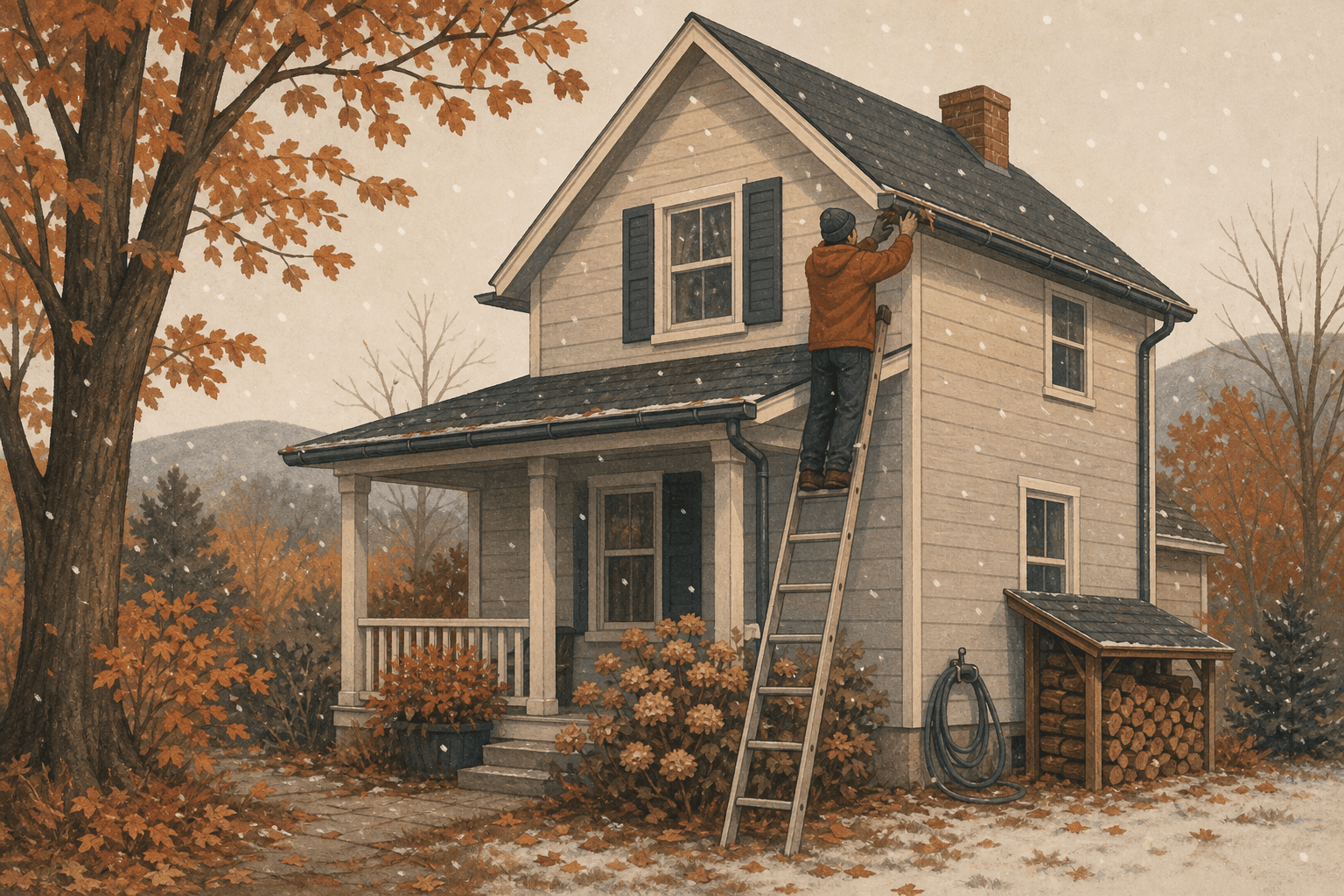
Getting a central Pennsylvania house ready for winter comes down to a short list of fall jobs: drain the outside spigots, clear the gutters, look the roof over from the ground, have the heat serviced before the first hard freeze, change the filters, and seal the drafts you can already feel. Most of it fits in one good weekend.
A winterize house checklist for Pennsylvania has to account for a climate that keeps swinging. October nights drop below freezing while afternoons stay mild, and that repeated freeze and thaw is what breaks things here. Nearly every job below moves water out of the way before December.
Key facts
- Finish the outdoor water work before the first hard freeze, which often arrives in October.
- Disconnecting the garden hoses is the highest-value ten minutes on the list.
- Overflowing gutters refreeze at the eaves and push meltwater under the shingle edge.
- Book heating service in early fall, before the first cold snap fills every schedule.
- Manufactured homes need extra attention at the skirting, the crossover duct, and any heat tape.
What should you do with outside spigots and hoses?
Disconnect every hose before anything else. A hose left screwed on traps water in the spigot and the pipe behind it, and freezing water in that pocket can split the line inside the wall, where nothing shows until spring.
Older hose bibs usually have a shutoff valve inside, on the supply line in the basement or crawl space. Close it, open the outdoor spigot to drain the line, and leave that handle open all winter. Frost-free sillcocks, the long-stem kind that close inside the warm wall, usually drain themselves once the hose is off, provided they were installed with a slight downward pitch to the outside.
How should gutters and downspouts be handled before winter?
Clean them after the leaves are down, then check them once more. Oaks around here hang on into November, so an early October cleaning usually leaves a second load waiting.
The downspout matters as much as the trough. Water should discharge past the backfill, onto ground that slopes away from the house. Gutters do not cause ice dams, though they do help concentrate ice and meltwater at the vulnerable roof edge. Dams form when heat leaking into the attic melts snow up high and that water refreezes at the colder eave. Where icicles line the same stretch of roof every year, the real fix is upstairs: air sealing and insulation at the attic floor.
What can you check on the roof from the ground?
More than most people expect. Stand back with binoculars and look for lifted, curled, or missing shingles, dark patches where the granules have worn away, and suspect flashing at the chimney, vent pipes, valleys, and where a lower roof meets a wall. On metal, look for backed-out fasteners, split washers, and rust at the panel ends.
Metal roofs fail at predictable spots, so knowing where metal roofs usually leak makes a ground check faster. Leave the climbing to someone equipped for it. Wet leaves and frost make an easy roof dangerous.
When should the heating system be serviced?
Early fall, before the first cold night. Annual service on an oil, gas, or propane system typically covers the burner, heat exchanger, flue, and safety controls, plus a nozzle and filter change on oil equipment. Finding a cracked part in October beats finding it at eleven at night in January.
The rest is yours. Change the air filter and keep checking it monthly, test every smoke and carbon monoxide alarm, and clear the space around the furnace. Heat pumps need clean filters and an outdoor unit sitting high enough that a plowed drift will not bury the coil. Cold-climate models handle winter here, though how mini splits perform in a central PA winter depends on sizing and placement.
Where do drafts actually come from?
Mostly the top and bottom of the house, not the windows. Warm air escapes through the attic hatch and plumbing chases, and cold air is pulled in low at the rim joist, the basement door, and gaps around the sill plate. Windows get blamed because you can feel cold glass standing next to one.
| Where cold gets in | Usual fix | How long it holds |
|---|---|---|
| Gap under an exterior door | Door sweep or adjusted threshold | Several years |
| Loose door edges | Foam tape or V-strip weatherstripping | A few seasons |
| Rattling double-hung sashes | Rope caulk in the sash gaps | One winter |
| Cold glass on old windows | Interior shrink film | One winter |
| Attic hatch | Weatherstrip plus rigid foam on the back | Long term |
Work top down. The attic floor pays back faster than anything at eye level.
How do you keep pipes on outside walls from freezing?
Keep cold air off them and warm air moving over them. Pipes freeze in the same places every year: the sink cabinet on an exterior wall, the unheated crawl space, and the garage ceiling.
- Seal the outdoor air leak first. A pipe rarely freezes because a room is chilly. More often it freezes because outside air reaches it through a rim joist gap or an open foundation vent.
- Add foam sleeves on exposed runs. Insulation slows heat loss but adds no heat, so it helps only a pipe that already has warmth reaching it.
- Open sink cabinets on exterior walls during a hard freeze, and let a thin trickle run overnight from the farthest fixture.
Find the main shutoff now and confirm the valve turns. If a line does let go, what you do in the first 24 hours after water damage shapes how big the repair gets.
What extras do mobile and manufactured homes need?
Skirting, heat tape, and the crossover duct. Close every gap in the skirting, because wind blowing under the home strips away the warmth that keeps water lines above freezing, and one missing panel can freeze a supply line on a windy night. Some manufacturers call for closing foundation vents over winter, so check the home's manual.
Heat tape on an exposed line should be listed for that pipe, plugged into a working outdoor-rated receptacle, and free of cracks. Worn tape is a fire risk, so replace it rather than patch it. Check the crossover duct too, the flexible duct running under a double-wide between the halves. If it is torn or lying in the dirt, one end of the home struggles to warm up. Sealing it is among the better returns in mobile home repair work.
Common questions
Is it too late to winterize once the cold has set in?
No. Draft sealing, filter changes, pipe insulation, and skirting repairs all work fine in the middle of winter. What gets harder is anything that has to cure in warm weather, since roof coating, caulk, and most sealants carry a minimum application temperature.
How low can the thermostat go when the house sits empty for a week?
No lower than about 55 degrees. That floor is the common recommendation for keeping pipes in exterior walls and unheated spaces above freezing, and it works better with interior doors and sink cabinets left open. For a longer absence, shutting the water off at the main and draining the system beats trusting the furnace.
Does homeowners insurance cover a burst pipe?
Policies typically cover sudden, accidental water damage from a pipe that bursts, and typically exclude damage that developed slowly from a leak nobody addressed. Many also limit freeze claims when a home is left unoccupied without heat. Read your own policy and ask your agent before winter.
What should you check before hiring someone for this work?
Ask for the Pennsylvania Home Improvement Contractor number. Contractors doing home improvement work in Pennsylvania are generally required to register with the state and to carry that PA HIC number on contracts and advertising. Registration is a starting point rather than a verdict, so ask for proof of liability insurance too.
Have a project like this in Lock Haven or Clinton County?