Burst pipe or leak in the house: what to do in the first 24 hours
What I tell homeowners to do in the first 24 hours after a burst pipe or appliance leak: stopping the water, documenting for the claim, and what usually dries versus what has to come out. Built on a 2025 washer-failure restoration I did in Lock Haven.
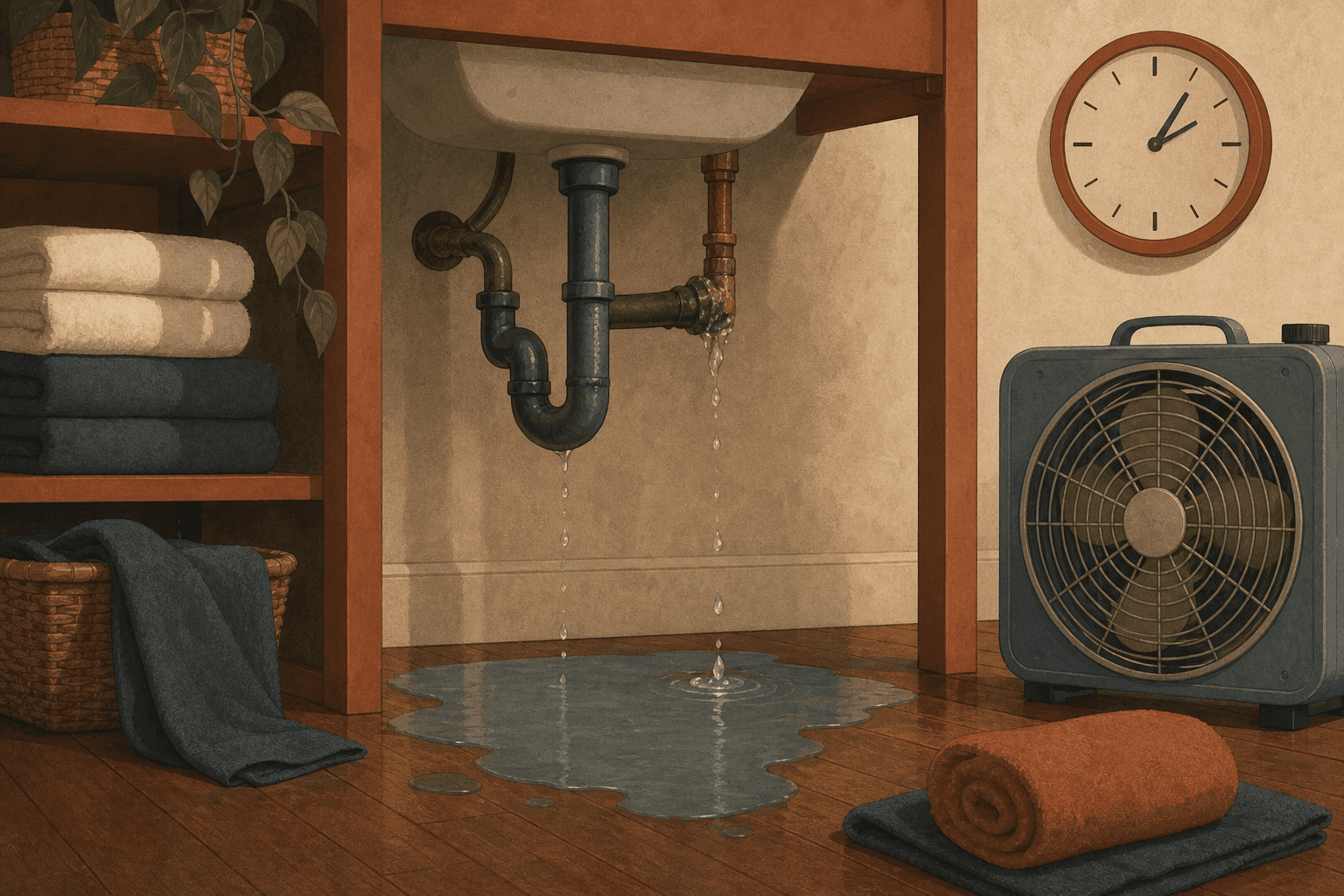
Shut the water off at the main. Kill power to the wet circuits if the panel is dry and you can reach it safely. Photograph everything before you move a single thing. Then pull out what can be saved, get air moving, and call your carrier, your insurance company. Last, get a contractor who documents what is there. Cleaning up before you document is what costs people on the claim.
Key facts
- The main shutoff is usually right where the supply line enters the basement or crawlspace. Find it on a dry day, not at two in the morning.
- Photos and video come before cleanup. Once soaked material is in a contractor bag, it stops being evidence.
- The working benchmark for drying is 24 to 48 hours on damp material that feeds mold. It is a target, not a promise in either direction.
- Water travels, so the stained ceiling is often several feet from whatever failed.
- What a policy covers is between you and your carrier. I document the damage and your carrier decides the claim.
- I handle the drying and the rebuild as one job: water damage restoration out of Lock Haven.
The sequence, step by step
- Stop the water. Use the main shutoff first, because it works whether or not you have found the failure. If you know which line let go and its valve turns, use that valve instead. On a washer, that is the two valves behind the machine. If that valve is seized, the water authority can close the curb stop, the shutoff at the street.
- Deal with the power carefully. If your panel is dry and you can reach it without walking through standing water, shut off the breakers feeding the wet rooms. If the panel sits in the wet area, leave it alone and call the utility.
- Photograph before you touch anything. Take a wide shot of each affected room from the doorway, then closer frames of the ceiling, flooring, baseboard line, and contents. Narrated video works too. Get the failed part itself: a split hose, a cracked fitting, the appliance. Your phone stamps the date and time on every shot, which is the point.
- Move what can be saved: paper, photographs, electronics, and anything with a wood or fabric bottom sitting on a wet floor. Put furniture legs up on blocks if the piece is too heavy to move.
- Get standing water out and air moving. Wet vac or mop, pull up soaked area rugs, open interior doors, and run whatever fans and dehumidifier you own on the wet surfaces. Keep receipts for anything you buy.
- Call your carrier and open the claim. Tell them when you found the water, what failed, and which rooms are wet. Ask what your policy requires of you to prevent further damage. Ask too whether they want an adjuster, the person who prices the damage, to come out before repairs begin.
- Get a contractor to look, and get one who writes it down. What you want from that visit is a scope: a written list of what is wet, how far the water went, what comes out, and what can be dried in place. Mine comes back in writing within 48 hours, and no deposit is due until you say go. Start that at get a quote.
Why the photos have to come before the cleanup
The most expensive mistake I see is cleaning up too well before anyone photographs the damage. Once the carpet pad is at the curb and the ceiling panel is in the truck, the only record is your description.
An adjuster prices what is visible on inspection day, so adding missed damage later rests on documentation you either have or do not. That is why insurance claim repairs live or die on paperwork.
Keep shooting once tear-out starts. Nobody can inspect a wall cavity, the hollow space between studs, once it is closed up.
Where the water shows up is rarely where it came in
Water runs along framing and pipe until something stops it, so the brown ring on the ceiling can sit well away from the break.
In 2026 I traced a leak on a metal roof in Loganton by wetting the roof a section at a time. Somebody stood inside under the stain and called out when the drip started. Fix the visible damage while the source is still leaking and you will do the work twice.
What usually dries and what usually comes out
This assumes clean supply-line water. A sewage backup or ground water changes the answers, and most of the soft, absorbent material that water touched leaves the house.
| Material | Usual outcome after clean water | Why |
|---|---|---|
| Framing lumber | Usually dries in place | Dense wood, and a moisture meter confirms it is dry |
| Plywood subfloor | Depends how long it stayed wet | Sound plywood dries. Springy spots or peeling layers mean it is done |
| Particle-board subfloor | Usually comes out | Swells and crumbles once water sits on it |
| Paper-faced drywall | Comes out as high as the water climbed | The paper face feeds mold and the gypsum holds water |
| Fiberglass insulation in a wet cavity | Usually comes out | Holds water against the framing and packs down flat |
| Carpet pad | Usually comes out | The open foam acts like a sponge |
| Laminate flooring | Usually comes out | The core swells at the seams and never goes back |
| Luxury vinyl plank | Often survives | The plank is waterproof, but water underneath stays put |
What fans can reach and what they cannot
Box fans and a household dehumidifier dry surfaces, and on a wet floor or damp baseboard they really help. What they cannot reach is anywhere closed in: a stud bay, under a floating floor, or a ceiling cavity holding soaked insulation.
Those spots need the cavity opened, real drying equipment on them, and moisture readings rather than a guess at how many days it takes.
The Lock Haven washer job in 2025
A second-floor washer let go in a Lock Haven house. Water went through the laundry area, into the ceiling cavity, and out into the finished room below. Gravity did the rest, which is how most of these jobs go.
That job opened with containment, meaning the work area sealed off, plus drying equipment and site protection. The ruined material came out and got hauled off.
Mold remediation followed: HEPA vacuuming and antimicrobial treatment on the affected areas before anything closed back up.
Then the failed sub-floor came out and went back in 3/4-inch plywood. The drop ceiling underneath was replaced, and new luxury vinyl plank and patched carpet finished it.
The estimate went to the carrier as a line-item scope, every task on its own line, plus overhead and profit, the markup that pays for running the business. Photographs taken while the cavity was still open went with the estimate. The write-up is at water-damage restoration in Lock Haven.
I am Thomas Darby, a registered Pennsylvania home improvement contractor (PA HIC #PA2199962). I do the dry-out and the rebuild myself, so the claim is not sitting open while you hunt down a carpenter. Almost everything that made that Lock Haven scope hold up was recorded before tear-out.
Common questions
Should I turn the power off after a burst pipe?
Yes, if the panel is dry and you can reach it without standing in water. Shut off the breakers feeding the wet rooms. The hazard is wet outlets, wet junction boxes, and cords in the water, not the pipe itself. If the panel sits in the wet area, stay out and call the power company or an electrician. No amount of saved flooring is worth getting that wrong.
How long do I have before mold becomes a problem?
Roughly 24 to 48 hours. That is the benchmark in the trade and in federal guidance for buildings, and it covers damp material that feeds growth: paper-faced drywall, insulation, cellulose, wood. Treat it as a drying target, not a deadline. Growth can begin sooner in a warm humid house, and it does not appear the moment 48 hours passes. Dry fast and check with a moisture meter.
Does homeowners insurance cover a burst pipe?
Your policy language decides that. It is between you and your carrier, not something a contractor can answer. What I can speak to is process. Open the claim quickly, document before cleanup, keep receipts for what you spend to limit the damage, and get a written line-item scope. How bad a room looks and how a policy reads are two different things.
Should I wait for the adjuster before cleaning up?
Ask your carrier when you open the claim, because expectations differ. Meanwhile, do the emergency work: stop the water, remove standing water, start drying. That work keeps the damage from growing and is normally expected of the homeowner. Hold off on tear-out and on throwing anything away until the damage is photographed and you are told to proceed.
If you are in Clinton County or the surrounding central-PA area and want the drying and the rebuild handled by one person, start with water damage restoration.
Have a project like this in Lock Haven or Clinton County?