Do mini-splits really work through a central PA winter?
Answers the cold-weather objection to ductless mini-splits with a real installed unit rated to keep heating at 13 below zero. Covers how heat pump output falls as the temperature drops, why sizing matters more than brand, defrost cycles, and what a Clinton County January actually demands.
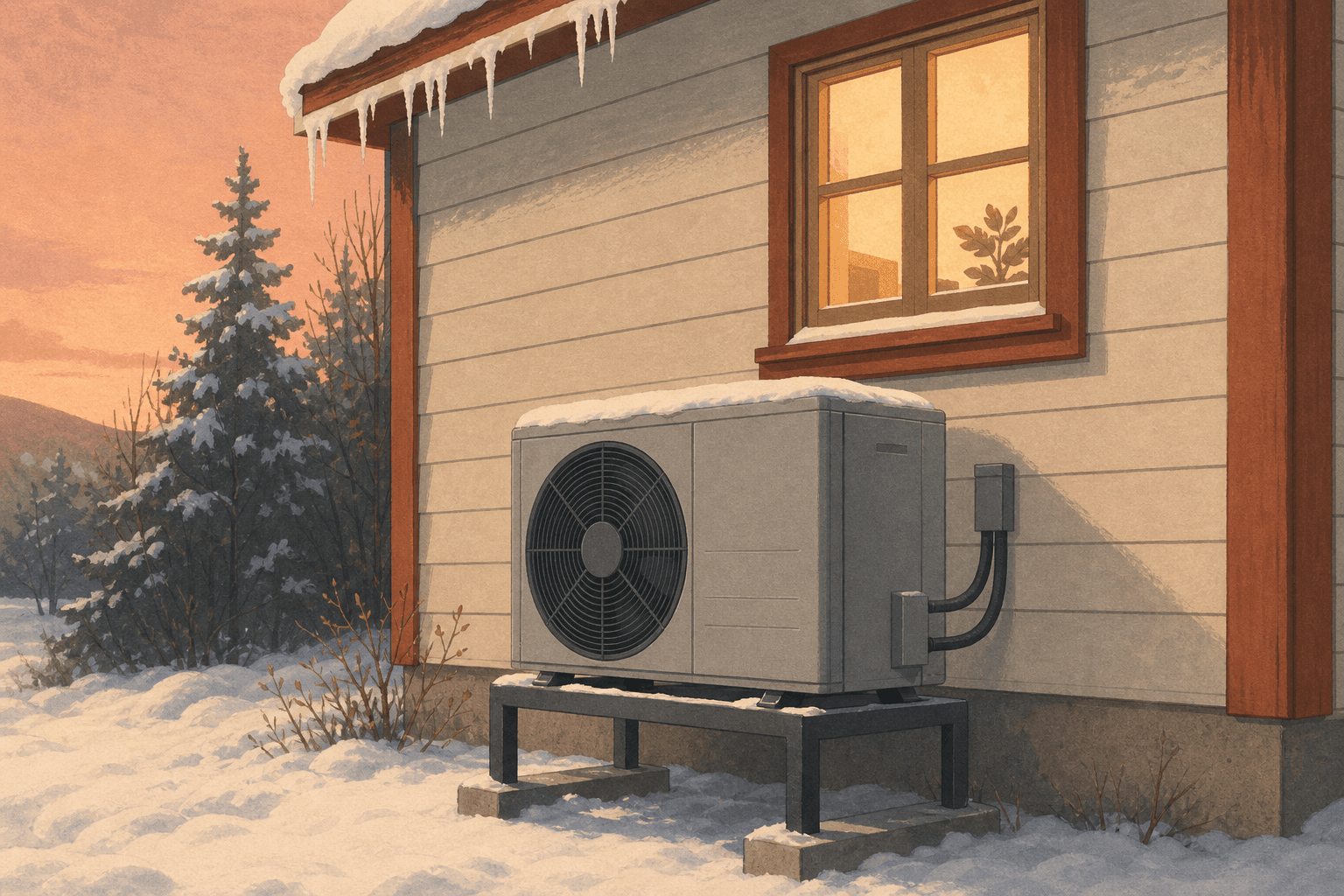
Yes, on two conditions. The unit has to be a cold-climate model, and it has to be sized for your room instead of guessed at. The Mitsubishi cold-climate unit I installed in Lock Haven, from their hyper-heat line, is rated to keep making heat at 13 below zero. A normal January morning in Clinton County bottoms out around 18 above, so the margin is wide.
- The Mitsubishi MSZ-FS18NA I installed in Lock Haven in 2024 is rated to keep making heat down to -13°F.
- The average January low in Lock Haven sits near 18°F, about 31 degrees above that unit's lowest rating.
- Heating output drops as the outdoor temperature drops, so capacity in your coldest weather beats the headline BTU on the box.
- Defrost cycles are normal. The outdoor unit steams for a few minutes, then goes back to heating.
- Cold-climate hyper-heat models and older standard mini splits are different machines. The bad winter reputation came from the older ones.
What a central PA January actually asks for
The average January low in Lock Haven sits around 18 degrees, and the town picks up close to thirty inches of snow in a normal year. The coldest reading on the long Williamsport record is 20 below zero, set January 21, 1994. One morning in about thirty years.
What matters is whether the unit still makes enough heat on the handful of genuinely cold mornings, when the wind is out of the northwest and the sun does nothing. A unit rated to 13 below has room to spare on nearly all of them. A mini-split installation around here is a bet on ordinary winters, and ordinary Clinton County winters never come close to 13 below.
Why capacity falls when the temperature does
A heat pump makes less heat as the air gets colder. It moves heat from outside air into the house instead of burning fuel. Colder air holds less heat per cubic foot, so the compressor works harder for less.
Two things move against each other as the thermometer drops: output falls while the house's heat loss climbs. Where those lines cross is what people mean when they say a heat pump quit on them in January.
| Outdoor temperature | What the heat pump is doing | What the house is doing |
|---|---|---|
| 40°F | Loafing at its lowest speed, cycling gently | Losing heat slowly, easy to hold |
| 20°F | Speeding up, output still well above demand | Steady load, comfortable margin |
| 5°F | Mitsubishi publishes full rated capacity for its Hyper-Heating line here | Load climbing, longer run times |
| -13°F | Still making heat, at reduced output | Highest load of the winter, runs almost continuously |
| Below the operating range | Shuts off on its low temperature limit, backup heat takes over | Nothing changed, the house wants the same heat |
Worth knowing: the headline BTU number is published at 47 degrees outdoors, a mild November afternoon. Ask for the manufacturer's extended capacity table, the one listing output at 17 above and below zero.
Sizing matters more than the badge on the box
Sizing decides more than the brand does. I have watched homeowners spend three weeks comparing brands and about ten minutes on sizing, which is backwards. Two units with the same cold-weather rating will both hold a correctly sized room. Neither rescues a room that needed more capacity than got ordered.
Oversizing is its own failure. An inverter compressor, the kind that speeds up and slows down instead of switching on and off, earns its efficiency running long and slow at partial load. Drop it into a room half its size and it short cycles, snapping on and off, which is noisy and wastes the technology you paid for. Undersize it and you find out during the second week of January.
Sizing starts with walking the room. I look at how much of the exterior wall is glass, what sits above the ceiling, and whether the space is one open room or bedrooms off a hallway with doors shut most of the day. One indoor head, the box on the wall that blows air, in one big open space is one calculation. The same head pushing warm air around a corner is a different one.
Defrost cycles, and why the outdoor unit steams
Steam rolling off the outdoor unit in winter is the defrost cycle, and it is correct operation. I get those calls every winter.
In heating mode the outdoor coil runs colder than the outside air, so moisture freezes onto it. Every so often the system reverses for a few minutes and melts the frost off. Indoor air goes neutral for a bit, then heating resumes.
What matters for a Pennsylvania install is where the meltwater goes. On the Lock Haven job I set the condenser, the outdoor half of the system, on leveled wall brackets with vibration pads. It sits high enough off the ground that defrost runoff drains away instead of icing up underneath. A condenser sitting low in a drift ices its own base, and the defrost cycle stops working right.
The Lock Haven install, and what install day decides
That 13-below figure is the unit's published heating rating, and it only holds up if the install is right. In 2024 I put a single-zone Mitsubishi MSZ-FS18NA into a house in Lock Haven. Single-zone means one indoor head and one outdoor condenser. 18,000 BTU, 21 SEER2 for cooling efficiency, heating and cooling one large room all year.
I hold EPA 608 Universal certification, the federal card for handling refrigerant, and I am a registered Pennsylvania home improvement contractor (PA HIC #PA2199962). Nobody else touched the refrigerant side of that job.
The system has to be tight and correctly charged. I pressure tested it with dry nitrogen at the manufacturer's test pressure and held it. Every flare, the joint where the copper line set meets the unit, got checked with bubble solution and an electronic leak detector. Then I pulled a deep vacuum below 500 microns and watched the micron gauge hold before refrigerant moved.
Extra R410A gets weighed in for line-set length instead of eyeballed off a gauge. A system carrying moisture or a slow leak at a flare will heat fine in November and let you down at 5 degrees. That is where it has no margin left to hide the fault.
Common questions
Do I still need a backup heat source?
For a whole-house conversion, yes, I would keep one. A cold-climate unit will hold the house through a 10-degree night, but a power outage or a failed control board is easier to ride out with a second heat source in the house. For a single room, an addition, or a garage conversion, the mini-split is usually the whole answer.
Will my electric bill jump in January?
Yes, January costs more to heat than October. Run hours climb in the coldest weeks and efficiency falls with the outdoor temperature. What moves that number is your insulation and air sealing, how much of the house the mini-split carries, and what you were heating with before. Against electric baseboard, a heat pump is the strongest comparison there is.
What should I set the thermostat to in winter?
Leave it alone at one steady setting. A deep setback, meaning dropping the temperature way down overnight, makes the system claw back a large swing at dawn, when it has the least spare capacity. Pick a temperature you are comfortable at and let the compressor speed up and down around it. Use the remote's heat mode rather than auto.
My old mini-split quit heating last winter. Will a new one do the same?
Depends on why the old one quit. A unit from fifteen years ago, built before hyper-heat, may have simply run out of capacity, and no repair fixes that. But a low charge, a leaking flare, a failed defrost sensor, and a bad control board all look the same from the couch. Getting gauges on it before condemning it is what a diagnostic call is for.
Whether a cold-climate mini-split fits your room is a question I can answer once I stand in the room. The mini-split installation page covers how I do the work, and a quote request gets it started.
Have a project like this in Lock Haven or Clinton County?