Soft spots in a mobile home floor: what causes them and how the repair is done
Why manufactured home floors go soft, the usual leak sources, how to find the edges of the damage, and the steps of a real subfloor repair: fix the water, cut to the joists, replace with plywood, close the belly.
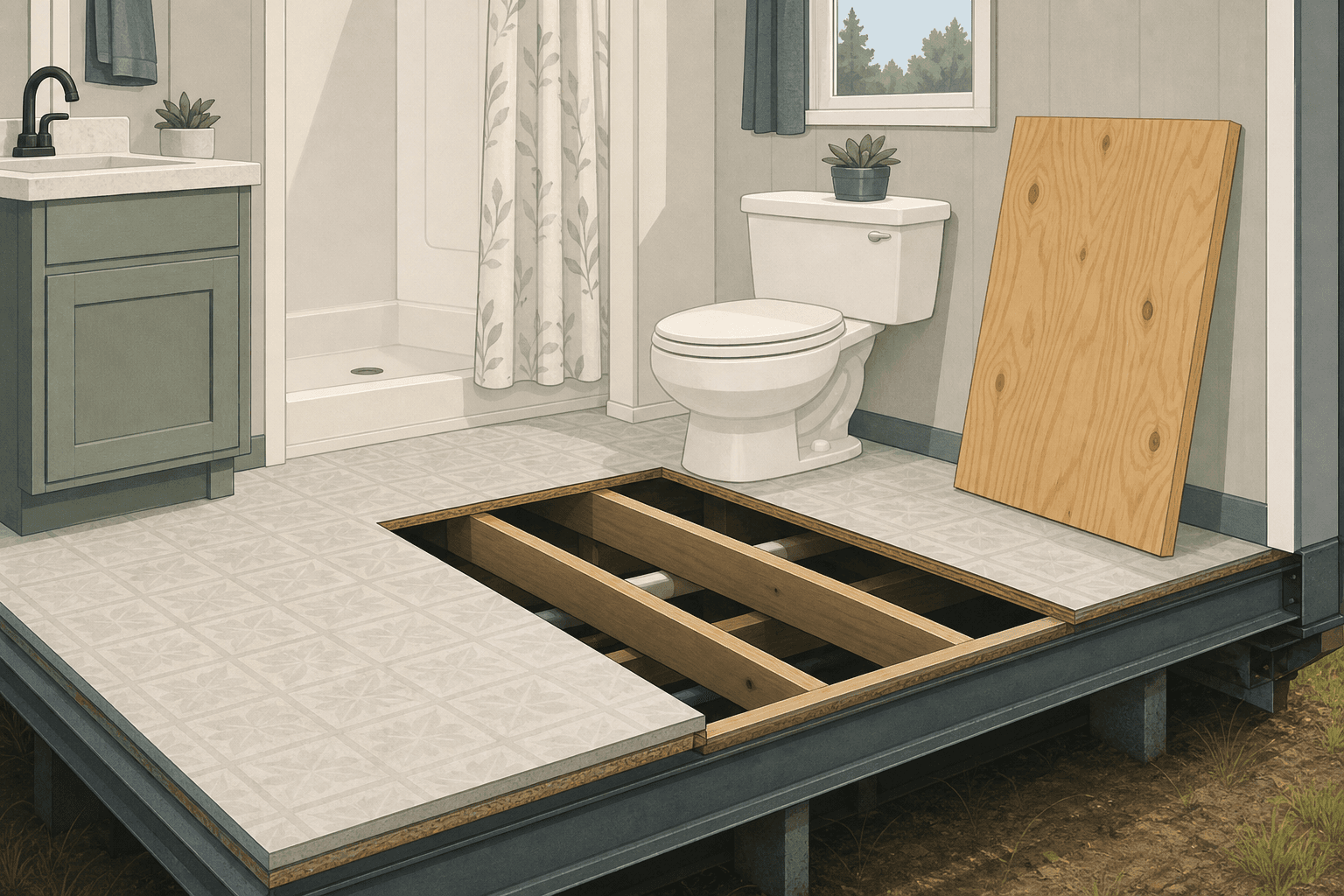
A soft spot in a mobile home floor is almost always water meeting the particleboard subfloor that most manufactured homes were built with. Particleboard is fine while it stays dry. Once it gets wet it swells, loses its glue, and turns into something closer to damp cardboard, and the spot you feel underfoot is usually smaller than the damage around it. The repair is straightforward when it is done in the right order, and the order starts with the water.
Key facts
- Particleboard subfloors, standard in manufactured homes for decades, do not dry out and recover. Wet particleboard stays weak.
- The soft spot is the middle of the damage, not the edge. The rot usually runs a foot or more past where the floor feels firm again.
- Bathrooms, the kitchen sink, the water heater closet, and exterior doors account for most of it.
- A torn belly wrap underneath lets ground moisture into the floor from below, and it is the cause nobody checks.
- Fixing the floor before fixing the leak means fixing the floor twice.
Where the water comes from
Start at the fixtures. In a bathroom, the toilet flange is the usual source: a wax ring that failed years ago, or a flange that sits below the finished floor, seeps a little with every flush. The tub or shower surround is next, where caulk at the corners and the tub lip lets water behind the wall and down into the floor. At the kitchen sink, a slow drip at the drain trap or the supply valves collects under the cabinet where no one sees it. The water heater closet is the same story.
Exterior doors leak at the threshold when the door sill is not sealed to the floor or the step outside slopes toward the house. Roof and wall leaks show up at the floor last, after running down inside the wall, so a soft spot along an exterior wall with no plumbing near it is a reason to look up. The metal roof leak article covers the roof side.
Then look underneath. The belly, the wrap under the floor that holds the insulation and keeps ground moisture out, tears when animals get in, when plumbing was repaired from below, or from age. A torn belly with the insulation hanging down lets damp air sit against the underside of the subfloor all year. Poor skirting and no ventilation underneath make it worse; the skirting article covers that.
Finding the edges
Walk the room in a grid and feel for give. Then push a screwdriver or an awl into the floor at the soft spot and work outward in a few directions until it stops going in easily. A moisture meter, if there is one available, finds the wet edge faster than a probe. In a bathroom, check under the vanity and behind the toilet, because the damage runs under the fixtures and the finished floor hides it.
The edge you find is where the cut will be, and it goes to the nearest joist center beyond it, so the new panel has something to land on. Joists in a manufactured home usually run across the width of the home on 16 inch centers, though older or wider homes vary.
How the repair is done
First, the water source gets fixed. A new wax ring and flange, a reset tub surround, a tightened trap, a sealed threshold, whatever it was. Then the floor:
- Pull up the finished floor over the damaged area and past it to the cut line.
- Cut the subfloor out in a rectangle centered on joists, so every edge of the new panel bears on wood. Screws or a circular saw set to the subfloor thickness, with care for the plumbing and any wiring below.
- Check the joists. Surface staining is fine. A joist that is soft where the probe goes in gets a new piece fastened alongside it, or gets replaced where the rot runs the full depth.
- Replace or dry the insulation, and repair the belly wrap from below with belly tape or a patch so the cavity is sealed again.
- Cut a new panel of 3/4 inch tongue and groove plywood to fit, glue the joists, and screw it down on the joist lines. Plywood is the right material here; it tolerates the next small leak in a way particleboard does not.
- Add blocking between joists under any panel edge that does not fall on a joist.
- Seal the panel edges and any cutouts around the flange or drains, then put the finished floor back.
For a bathroom, this is often the moment the room gets renovated rather than patched, because the floor comes out from under everything anyway. The bathroom remodel article walks through what that involves.
Patch or the whole room
A soft spot the size of a bath mat, with a clear cause, is a patch. Rot that runs under two or three fixtures, or that shows up in more than one room, is a floor. Replacing an entire room's subfloor costs more than a patch but it is done once, and it lets the whole room get sealed plywood instead of a plywood patch surrounded by old particleboard that will go soft next.
If the frame outriggers or the main joists under the soft area are rotted, the job has moved from floor repair to structural repair, and it needs to be assessed from below before anyone cuts anything from above. That is also the point where the mobile home repair page applies rather than a handyman visit.
Common questions
Can I just screw down a piece of plywood over the soft spot?
It hides the problem and traps the moisture. The wet particleboard under it keeps rotting, spreads to the joists, and the toilet flange or fixture on top of it ends up sitting on nothing.
Will the floor dry out on its own if I fix the leak?
Plywood might. Particleboard does not. Once it has swollen it has lost the glue that held it together, and it stays weak after it dries.
How can I tell if it is the belly instead of a leak?
A soft floor with no plumbing or door nearby, especially along the center of the home, points at moisture from below. Looking under the home with a flashlight for hanging insulation or a torn wrap usually confirms it.
Is a soft floor a sign the home is not worth fixing?
Almost never. The subfloor is a replaceable layer over a steel frame. Floors, roofs, and bathrooms are the normal maintenance of an older manufactured home, and a plywood subfloor is an upgrade over what the home left the factory with.
If you have found a soft spot, find the water first and note how far the give runs. Both facts change the estimate. Describe it here, and a photo of the area, including underneath if you can get to it, helps.
Have a project like this in Lock Haven or Clinton County?