Frozen pipes: what to do, and how to keep them from freezing
A plain-English winter guide for central Pennsylvania homeowners: why frozen pipes burst, the prevention that actually works, safe and unsafe thawing methods, mobile home underbelly checks, and the steps to take when a line lets go.
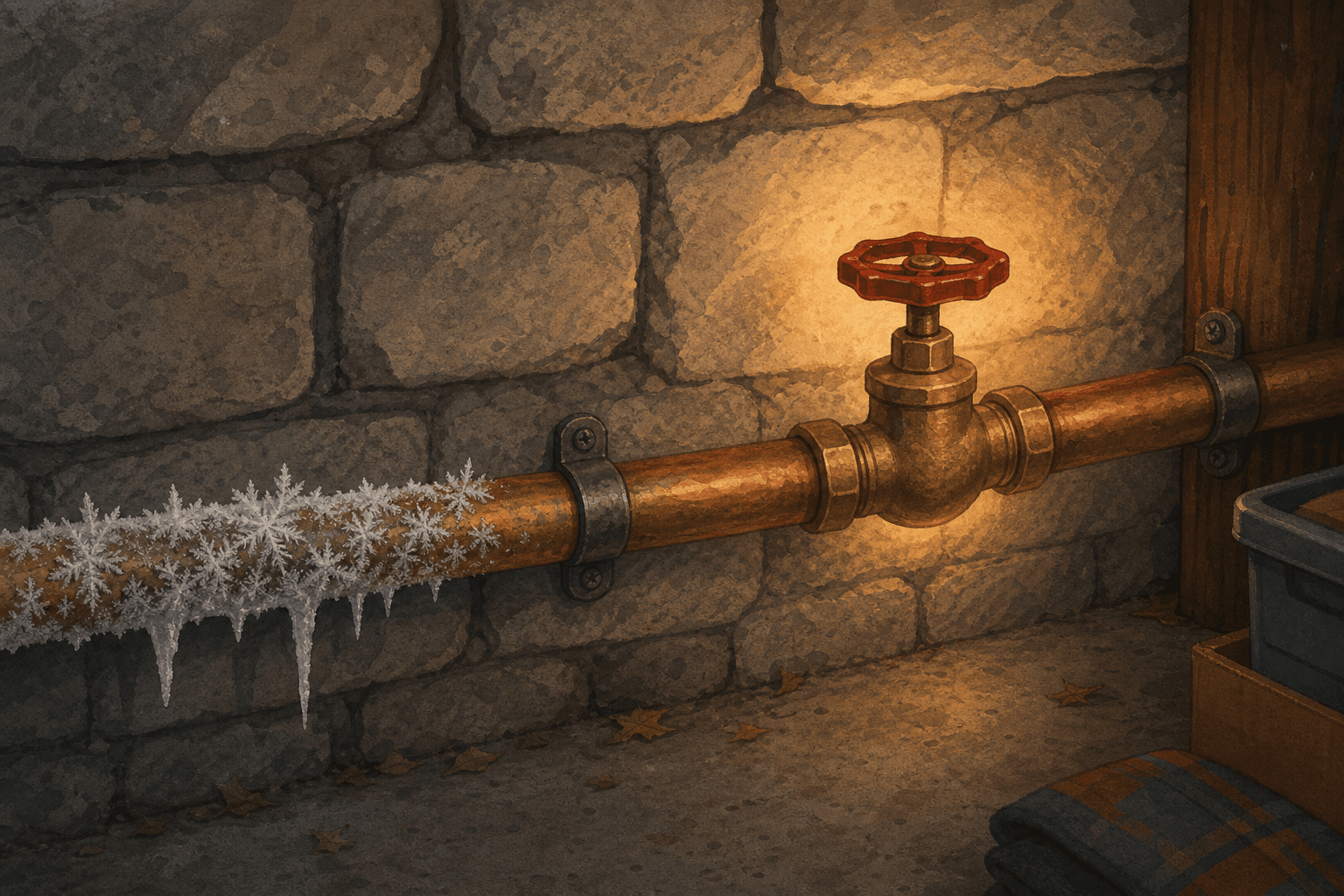
A faucet that sputters and quits on a subzero morning usually means ice in the line. With frozen pipes what to do first is simple: locate the main water shutoff, then open the affected faucet and warm the frozen run gently from the fixture back toward the cold spot with a hair dryer or heat lamp. Never use an open flame, and stay with the pipe until full pressure returns. Keeping them from freezing at all comes down to steady heat overnight, open cabinet doors under sinks on exterior walls, a trickle from the most exposed fixture during a hard freeze, and insulation or listed heat tape on the runs that freeze every year.
Key facts
- Water expands as it freezes, and the split usually happens between the ice plug and a closed faucet, not at the ice.
- Pipes in exterior walls, crawl spaces, attics, unheated garages, and mobile home underbellies freeze first.
- A split pipe often stays dry until the ice melts, so watch the line after flow returns.
- Never thaw a pipe with an open flame, and never pour boiling water over cold pipe.
- Find the main water shutoff before the first hard freeze, not during one.
Why do frozen pipes burst?
Pipes burst because the ice plug blocks the line and the water trapped between that plug and a closed faucet has nowhere to expand. Pressure climbs until the weakest point gives, which is why the split often shows up several feet from the ice. Copper usually splits lengthwise along the tube wall and CPVC can crack outright. PEX survives freezing more often than rigid pipe, though its fittings stay vulnerable. No common supply material is freeze proof.
How do you keep pipes from freezing?
Keep the heat on and steady, overnight and while the house is empty. A hard setback on the coldest nights of the year turns a marginal pipe run into a frozen one. The rest is habit:
- Open the cabinet doors under sinks on exterior walls so room air reaches the supply lines.
- Run a thin trickle during a hard freeze from the most exposed fixture, commonly the one served by the longest run of unheated pipe. Moving water resists freezing, and an open faucet gives expanding ice somewhere to go.
- Insulate accessible runs in crawl spaces, basements, and garages with foam sleeves, and seal the drafts where lines pass through the rim joist or skirting. Moving cold air is worse than still cold air.
- Disconnect garden hoses in fall and drain the hose bibs. A connected hose holds water against the valve and freezes it from the outside in.
- Keep the garage door closed if any water line runs through that space.
When is heat tape worth installing?
Heat tape earns its keep on one run that freezes year after year and cannot practically be rerouted or better insulated. Buy a product listed by a recognized testing laboratory and rated for your pipe material, since some tapes are made for metal only and can damage plastic. Follow the instructions on how much insulation may go over it. Check it each fall for a cracked jacket or a damaged plug.
What about mobile home pipes and the underbelly?
In most manufactured homes the water lines run in the underbelly, protected by batt insulation and a belly wrap rather than by heated living space. That wrap is the whole system. Once it is torn open by an animal or road debris, the insulation sags out, the lines sit in open air, and the first cold snap finds them. Before winter, look underneath for intact skirting and no daylight through the belly board. Torn belly board causes repeat freezing and is worth a real mobile home repair rather than a tarp and a strap.
What should you do the moment you find a frozen pipe?
Open the faucet that the frozen line feeds, both handles, so melting water and pressure have an exit. Then work the problem in order:
- Find the main shutoff and clear anything stacked in front of it, so you can close it fast if the pipe turns out to be split.
- Track down the cold run, almost always in an exterior wall, a crawl space, an unheated garage, or under a sink on an outside wall.
- Apply gentle heat at the faucet end and work back toward the frozen area, so meltwater has an open path out.
- Keep heating until full pressure returns. Partial flow means there is still ice in the line.
- Watch the pipe, and the ceiling or floor below it, for at least an hour after flow comes back.
If the frozen section is inside a finished wall, or you cannot find it, call a plumber.
Which thawing methods are safe?
| Method | What it does | Use it? |
|---|---|---|
| Hair dryer on low, kept moving | Controlled heat at the accessible end | Yes, the usual first choice |
| Heat lamp or space heater aimed into the cabinet | Warms the pocket of cold air around the pipe | Yes, with clearance from anything combustible, never unattended |
| Warm wet towels wrapped on the pipe | Slow, safe heat in tight spots | Yes, refresh them often |
| Listed heat tape sold for freeze protection | Depends entirely on the product | Only per the manufacturer's instructions |
| Boiling water poured over the pipe | Thermal shock to cold metal or plastic | No |
| Propane torch or any open flame | Ignites framing and insulation | Never |
What do you do if the pipe already burst?
Shut the water off at the main, then cut power to the affected area at the breaker if water is near outlets, fixtures, or the panel. Open faucets to drain the pressure, get belongings up off the floor, and photograph everything before cleanup starts, since those pictures carry weight with an adjuster later. Then drying starts the clock, because soaked drywall and subfloor turn moldy fast once the heat comes back on. The full sequence is in the first 24 hours after water damage, and the repair side is covered under water damage restoration.
Watch for the thaw leak. A pipe can split while frozen and show nothing, because the ice is still plugging the hole. The water arrives later, sometimes after everyone has decided the emergency is over.
Common questions
How long does it take to thaw a frozen pipe?
An accessible run under steady gentle heat often opens up in roughly half an hour to an hour, depending on how cold the space is and how long the ice has been building. A line inside a wall takes longer, since the heat has to travel through framing and insulation first. If nothing has changed after an hour, call a plumber.
Should you leave a faucet dripping all winter?
No. A trickle is a hard freeze tactic rather than a season long habit. Use it on nights when the temperature drops well below freezing and stays there, and only on the fixtures fed by the most exposed lines.
Does homeowners insurance cover a burst pipe?
Policies typically cover sudden and accidental water discharge from plumbing and the resulting damage to the structure and contents. Many exclude losses in a home left unheated or vacant without the water shut off and drained, and the failed pipe itself is often handled differently from the water damage it caused. Read your policy or ask your agent, and report the loss promptly. Insurance claim repairs explains how a contractor's estimate and an adjuster's scope fit together.
Should you call a plumber or a contractor?
Call a plumber for the pipe itself, and a contractor for everything the water touched: wet drywall, insulation, flooring, cabinets, and trim. In Pennsylvania, most home improvement contractors are required to be registered with the state and to show a PA HIC number on contracts, so ask for that number before work starts.
What should the thermostat be set to when the house is empty?
Common guidance is to hold the house no lower than 55 degrees while you are away in winter, with interior doors left open so heat reaches the rooms that contain plumbing. For a longer absence, shut the water off at the main and drain the system, so a heating failure cannot become a flood with nobody there to hear it.
Have a project like this in Lock Haven or Clinton County?