Mini split maintenance a homeowner can actually do
A plain English guide to mini split maintenance for homeowners: how often to wash the filters, how to keep the outdoor unit clear through snow and leaf season, how to rinse coils without wrecking the fins, and what short cycling or ice on the line set is telling you.
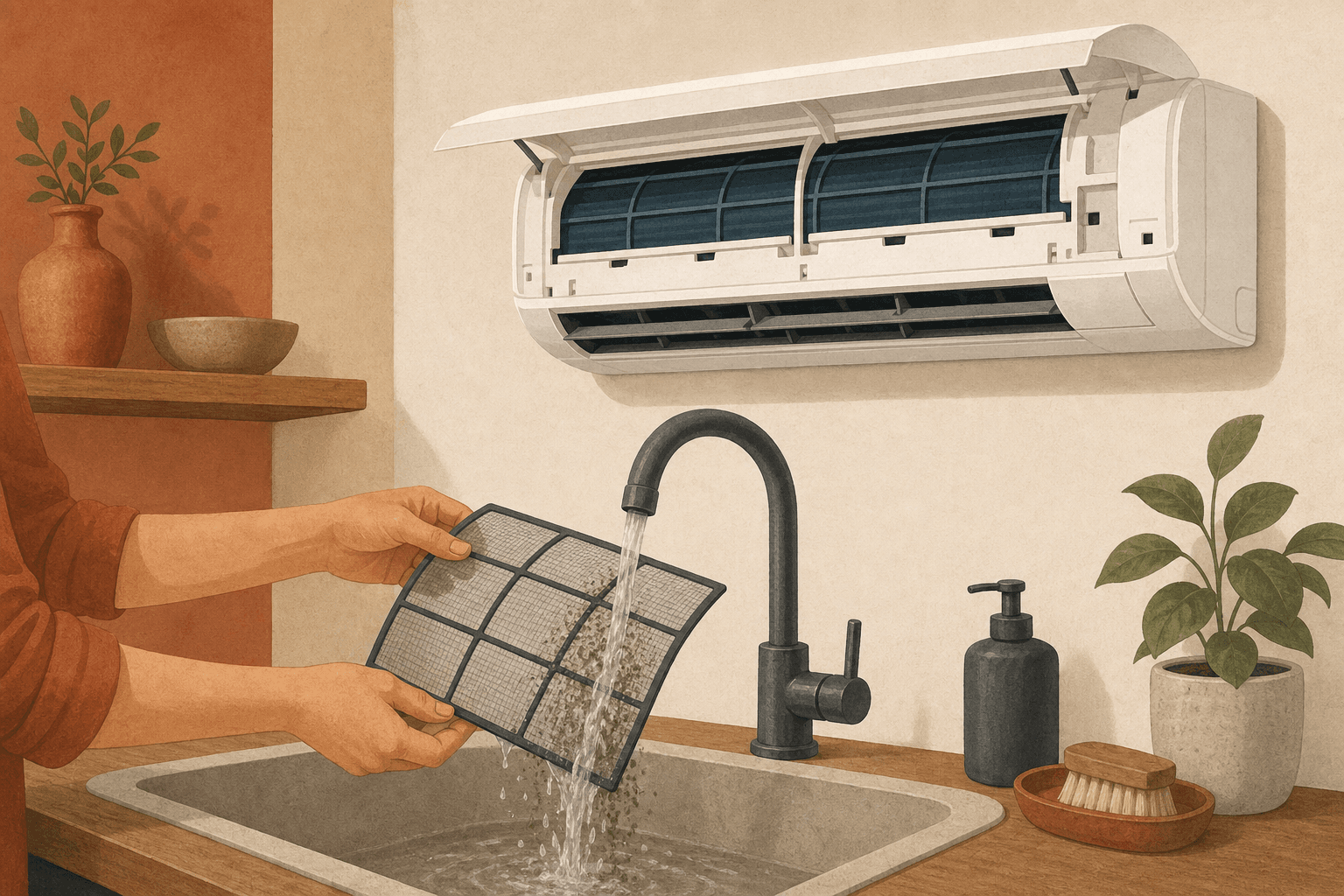
Mini split maintenance is mostly filter work. Wash the indoor filters roughly once a month during the season you run the system hardest, keep the outdoor unit clear of snow, leaves, and dryer lint, and give the coils a gentle rinse once or twice a year. Anything involving refrigerant belongs to a technician certified under EPA Section 608.
- Washable mesh filters need water, a soft brush at most, and a full dry before they go back in.
- A restricted filter costs efficiency long before anyone notices a comfort problem.
- The outdoor unit needs open air on every side, including above the snow line.
- Servicing the refrigerant circuit is federally restricted to EPA 608 certified technicians.
- Short cycling and ice that never clears are service calls, not homeowner fixes.
What can you handle, and what needs a certified tech?
You can handle anything outside the sealed refrigerant circuit and the electrical compartment. Once a job calls for gauges on a service port, it belongs to a technician. Section 608 of the Clean Air Act requires certification for anyone who services equipment holding regulated refrigerant, and suppliers generally will not sell it without proof of certification. Charge is also not a consumable. A system running low has a leak, and topping it off loses the refrigerant twice.
| Task | Who does it | Why |
|---|---|---|
| Washing the indoor filters | Homeowner | Tool free, water only |
| Clearing snow, leaves, and lint outdoors | Homeowner | Airflow, nothing opened |
| Gentle coil rinse with a hose | Homeowner, power off | Low pressure only |
| Blower wheel and evaporator deep clean | Certified tech | Disassembly and a bib kit |
| Charge checks, leak repair, recovery | EPA 608 certified tech | Federally restricted |
| Diagnostics at the disconnect or board | Certified tech | Live circuits |
How often should you wash mini split filters?
Monthly is the safe default through the season you use the system hardest, and manufacturer manuals commonly call for that interval or a shorter one. Open the front panel, lift the mesh filters out, vacuum the loose dust, then rinse from the clean side with lukewarm water. A little dish soap handles kitchen grease. Let them dry completely first, because a damp filter dropped into a running head can give mold a place to start. Pets and wood heat load them faster. Some heads carry a deodorizing cartridge behind the mesh, and that gets replaced on the manual's schedule rather than washed.
Why does a starved filter quietly kill efficiency?
Because nothing breaks. The system just works harder for the same result. A ductless head moves heat by pulling room air across a coil, and a loaded filter chokes that airflow. Less air over the coil means less heat moved per minute, so the compressor runs longer and harder to reach the setpoint. In cooling, the coil runs colder than designed and can drop below freezing, so condensate turns to ice. In heating, capacity fades on the nights you want more of it. Power use climbs well before comfort suffers, which is how a choked filter goes unnoticed for a season. A correctly sized mini split installation leaves less slack to absorb the loss.
What does the outdoor unit need through a central Pennsylvania winter?
Open air and a clear base. In heating mode the outdoor unit pulls heat from outside air, so it needs unobstructed flow through the fins and room for defrost water to drain away. Mounting height matters. A unit set low on a pad can end up buried, and drifting snow packs the coil solid. Keep a foot or two of clearance on every side and check it after storms. Watch for meltwater refreezing into a slab that reaches the fan blade. Clear snow by hand or with a soft brush, and never chip ice off a coil with anything metal. A clothes dryer aimed at the condenser coats the fins in lint, and lint plus moisture becomes a mat that runtime will not clear. See how mini splits handle a central Pennsylvania winter for more on defrost behavior.
Can you rinse the coils yourself?
Yes, with the power off and the pressure low. Kill power at the disconnect or the breaker first and confirm the fan is dead. Use a garden hose with an ordinary nozzle, never a pressure washer, which folds aluminum fins flat and ruins the heat transfer you were trying to restore. Spray straight through the fins rather than at an angle, and skip acid based cleaners that need careful rinsing and containment. Let it dry before power goes back on. Indoor heads are different. The blower wheel behind the coil needs the head opened and washed with a bib kit, which is tech work.
What is short cycling telling you?
That the system cannot settle into steady output. Inverter driven mini splits ramp up and then run at a low continuous rate, so a head that starts and stops every few minutes is fighting something. The cheapest explanation is a dirty filter or a blocked coil, so check those first. Past that: low charge, a failing sensor, a control board fault, or a head oversized for the room. If the pattern continues on a clean filter and a clear coil, schedule HVAC repair rather than keep running it. Repeated starts are hard on a compressor.
When does ice on the line set mean stop?
Light frost on the outdoor coil in heating weather is normal, and the unit melts it off during a defrost cycle. Ice is a different signal. A thick shell that never clears, ice riding on the insulated refrigerant lines, or frost on the indoor coil in cooling mode points toward restricted airflow or a refrigerant problem. Shut the system off, run fan only mode if the unit has one so the ice thaws gently, and check the filters. Do not chip at it. If ice returns on a clean filter and a clear coil, stop running the system, because an iced coil can send liquid refrigerant back to the compressor.
Common questions
Does a mini split need professional service every year?
Yearly suits a system in regular use, twice for one that heats and cools hard. A technician verifies charge, cleans the blower wheel and coil surfaces you cannot reach, flushes the condensate line, and tightens electrical connections. Filter work between visits helps, but it does not replace the visit.
What causes the sour smell when a mini split starts up?
Moisture sitting on a dirty evaporator coil and blower wheel. In cooling mode the indoor coil condenses water out of the air, and growth on a dusty coil is what you smell. Many units have a dry or self clean mode that runs the fan after shutdown, which helps. A smell that survives a filter cleaning means the blower wheel is due.
Should the outdoor unit be covered for the winter?
Not if the system provides heat. That unit runs all winter and needs airflow, so a wrap or a box around it is a real hazard. On a cooling only system, a top cover that blocks falling ice while leaving the sides open is fine.
Can a homeowner add refrigerant to a mini split?
No. Handling regulated refrigerant requires EPA Section 608 certification, and suppliers generally will not sell it without proof of certification. Low charge is a symptom rather than a maintenance item. The circuit is sealed, so a system running low has a leak that has to be found and repaired first.
Does skipping maintenance affect the warranty?
It can. Manufacturers typically make proper installation and documented service a condition of coverage, and failures traced to a filthy coil are often denied as neglect. Keep the installation paperwork and service receipts. For a manufactured home, mini split heating in a mobile home covers sizing and placement.
Have a project like this in Lock Haven or Clinton County?