How deep deck footings need to go in Pennsylvania and why
A plain-English guide to deck footing depth in Pennsylvania: what a footing is, how the frost line sets the depth, what frost heave does to railings, ledgers, and doors, how sono-tube piers are poured, and why the footing inspection happens before any concrete goes in.
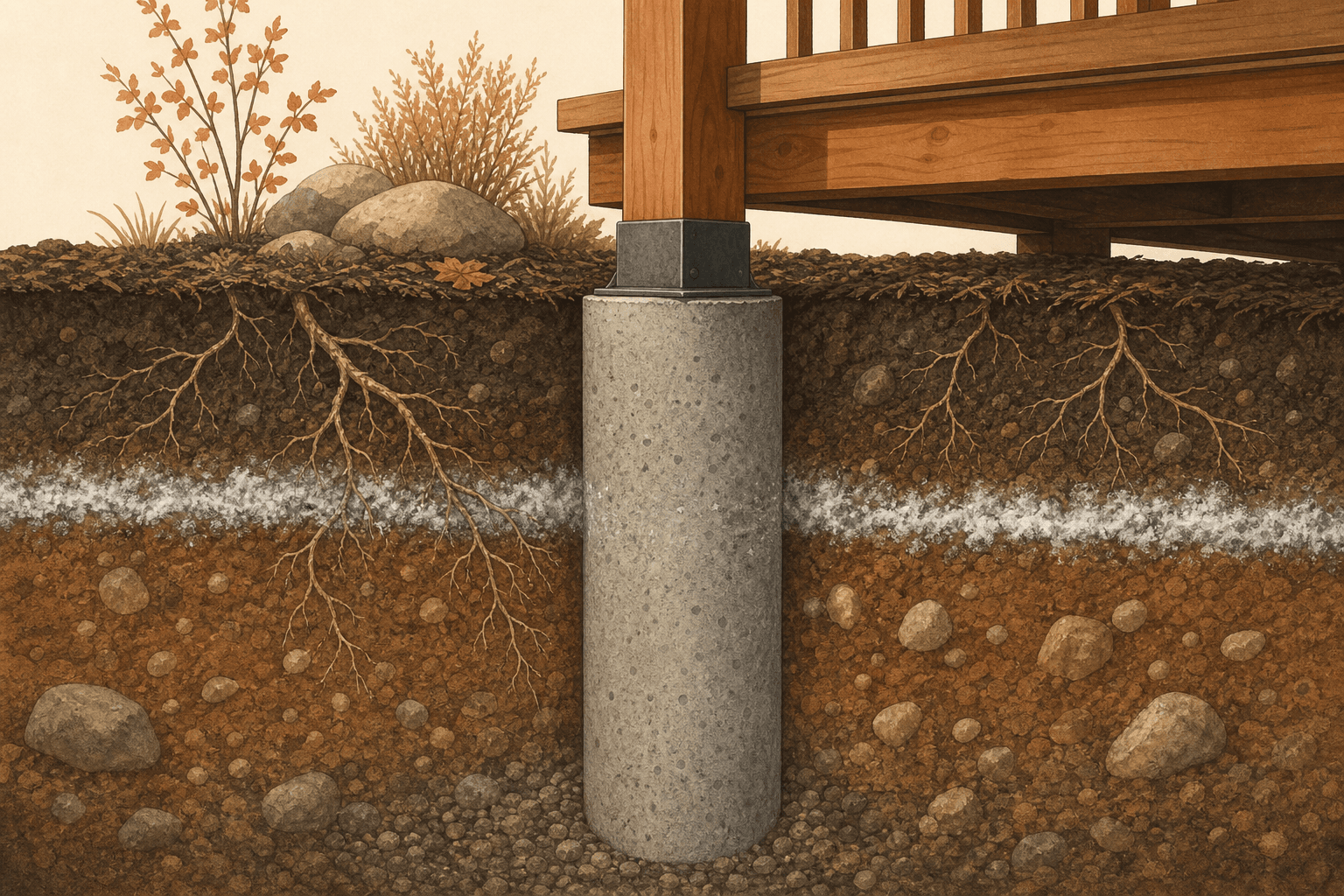
Deck footing depth in Pennsylvania is governed by the frost line, and across much of the state that depth is commonly taken as roughly 36 inches below finished grade. The number that actually applies to your project is the one your local code official puts on the permit, so confirm it with your municipality before anyone digs. Footings that stop above frost depth tend to lift over a winter and settle back unevenly, which pulls a deck out of alignment.
- A footing is the concrete base under each deck post, sized to spread the load onto soil that stays put.
- The frost line is how deep the ground typically freezes, commonly figured at about 36 inches across much of Pennsylvania.
- The depth that governs your build is the one your municipal code official enforces, which varies by location and elevation.
- Where a permit is issued, the open holes are typically inspected before any concrete goes in, because depth cannot be verified afterward.
- Frost heave shows up as racked railings, a ledger pulling away from the house, and doors that suddenly bind.
What is a deck footing?
A footing is the mass of concrete buried under each deck post that carries the deck's weight down to stable ground. It does two things: spreads a concentrated load over enough soil that the ground does not compress, and puts the bearing surface deep enough that seasonal freezing cannot reach it. Most are round concrete piers, sometimes widened at the base, finishing a few inches above grade where a galvanized standoff bracket keeps the post out of standing water.
How deep do deck footings need to go in Pennsylvania?
Deep enough that the bottom bears below the local frost line, which across much of Pennsylvania is commonly taken as about 36 inches. That number gets repeated so often that people treat it as statewide law, and it is not. Pennsylvania has a statewide Uniform Construction Code, but permits and inspections are administered locally, and the frost depth applied to your project is set by the office issuing the permit. Colder, higher ground in the northern tier may use a deeper figure.
Two details trip up homeowners. Depth is measured from finished grade, not from wherever the shovel started. And the footing has to bear on undisturbed soil, so a hole with loose spoil raked back into the bottom is not at depth.
Why does the frost line decide the depth?
Because water expands when it freezes, and soil is full of water. As the freezing front moves down, moisture migrates toward it and forms lenses of ice that take up more room than the water did. The soil above has nowhere to go but up, and it carries along whatever is sitting in it. Below the frost line the ground normally stays above freezing through the winter, so it does not swell the same way. Soil type matters too: silt and clay heave hard, clean gravel less.
What does frost heave actually do to a deck?
It lifts one part of a deck and not the others, and the damage compounds every winter. A shallow footing rises as the soil swells, settles back imperfectly in spring, and ratchets the structure further out of alignment with each freeze. By the second or third winter the signs are easy to read:
- Railings rack. Square openings turn into parallelograms and balusters lean one way.
- The ledger pulls. The board bolted to the house gets pried on, bolt holes elongate, and the flashing above it opens up and lets water into the rim joist.
- Doors bind. A door onto the deck that drags or will not latch usually means the framing under it moved.
The ledger connection is one of the most common failure points on any deck, so a footing that moves is a structural problem rather than a cosmetic one. If a deck already shows these signs, have the footings evaluated before the ledger takes more abuse. Sound deck and porch work starts at the foundation.
How do sono-tube pier footings work?
A fiber forming tube, usually called a sono-tube after the common brand, is a waxed cardboard cylinder that shapes the concrete pier inside the hole. The crew digs to depth, cleans loose material out of the bottom, braces the tube plumb, then fills it with concrete and beds an anchor bracket in the wet mix so the post lands on hardware instead of soil.
The tube also leaves a smooth exterior, which matters because freezing soil can grip rough concrete along its sides and lift the pier even when its base sits below frost depth. That effect is called adfreeze. Backfill gets compacted in layers, and the pier top is crowned so water sheds off it.
| Footing method | How it handles frost | Where it usually fits |
|---|---|---|
| Poured pier in a fiber tube | Bears below frost, smooth sides limit adfreeze | The default for attached decks |
| Poured pier with a widened base | Same frost protection, more bearing area | Taller decks, roofed porches, heavier loads |
| Helical pile | Screwed below frost depth to a rated torque | Rocky or wet ground, hard access |
| Precast on-grade blocks | No frost protection at all | Small freestanding platforms, where allowed |
Why does the footing inspection happen before the concrete is poured?
Because once the hole is full of concrete, nobody can tell how deep it was. The inspection is a look at open holes, and the inspector checks depth, diameter, bearing on undisturbed soil, and whether the pier locations match the approved plan. Do not pour ahead of it. If concrete goes in first, the code official can require the work be uncovered or replaced.
How does the permit process protect the homeowner?
A permit puts a second set of trained eyes on the structural decisions before they get buried. Plan review covers beam spans, joist sizing, post loads, footing size, and the ledger attachment, and the inspections that follow confirm the built work matches what was approved. A permitted deck is also documented when the house sells, and unpermitted structural work can complicate an insurance claim later. See the guide to home improvement permits in Clinton County for how local permitting runs in practice, and confirm the builder holds a current PA Home Improvement Contractor registration, which is a state registration rather than a license and takes a minute to verify by PA HIC number.
Common questions
Does every deck need footings below the frost line?
Assume yes for anything attached to the house, since a deck that heaves takes the ledger and the wall behind it along with it. Small freestanding platforms close to grade are sometimes allowed on shallower foundations, but that call belongs to the municipality issuing the permit.
What happens if a deck already sits on shallow footings?
It can usually be corrected without tearing the whole deck off. The common fixes are new full-depth piers set alongside the failing ones with the load transferred over, or helical piles where digging is impractical. Handling it before the ledger is damaged keeps the repair smaller.
Can deck footings be dug and poured in winter?
Yes, with precautions. The bottom of the hole has to be free of frozen soil, because frozen ground will thaw later and settle under the footing. Fresh concrete also needs protection while it cures, whether from blankets, a heated enclosure, or a cold weather mix.
How wide does a deck footing need to be?
Diameter comes from the load each post carries and the bearing capacity of the soil, both worked out on the permit drawings rather than guessed at in the yard. Roofed porches and anything supporting a hot tub concentrate more weight on fewer posts and need larger footings.
Do wheelchair ramps need the same footing depth?
Usually yes, because a permanent ramp is framed much like a deck and heaves the same way. A ramp that shifts over a winter loses its running slope and develops lips at the landings, which turns an accessibility feature into a hazard. See the guide to wheelchair ramp requirements in Pennsylvania.
Have a project like this in Lock Haven or Clinton County?