Furnace not turning on? What to check before you call for repair in central PA
A no-heat furnace is usually one of a handful of things, and several of them a homeowner can check in ten minutes. Here is the order a technician checks them, and where to stop and call.
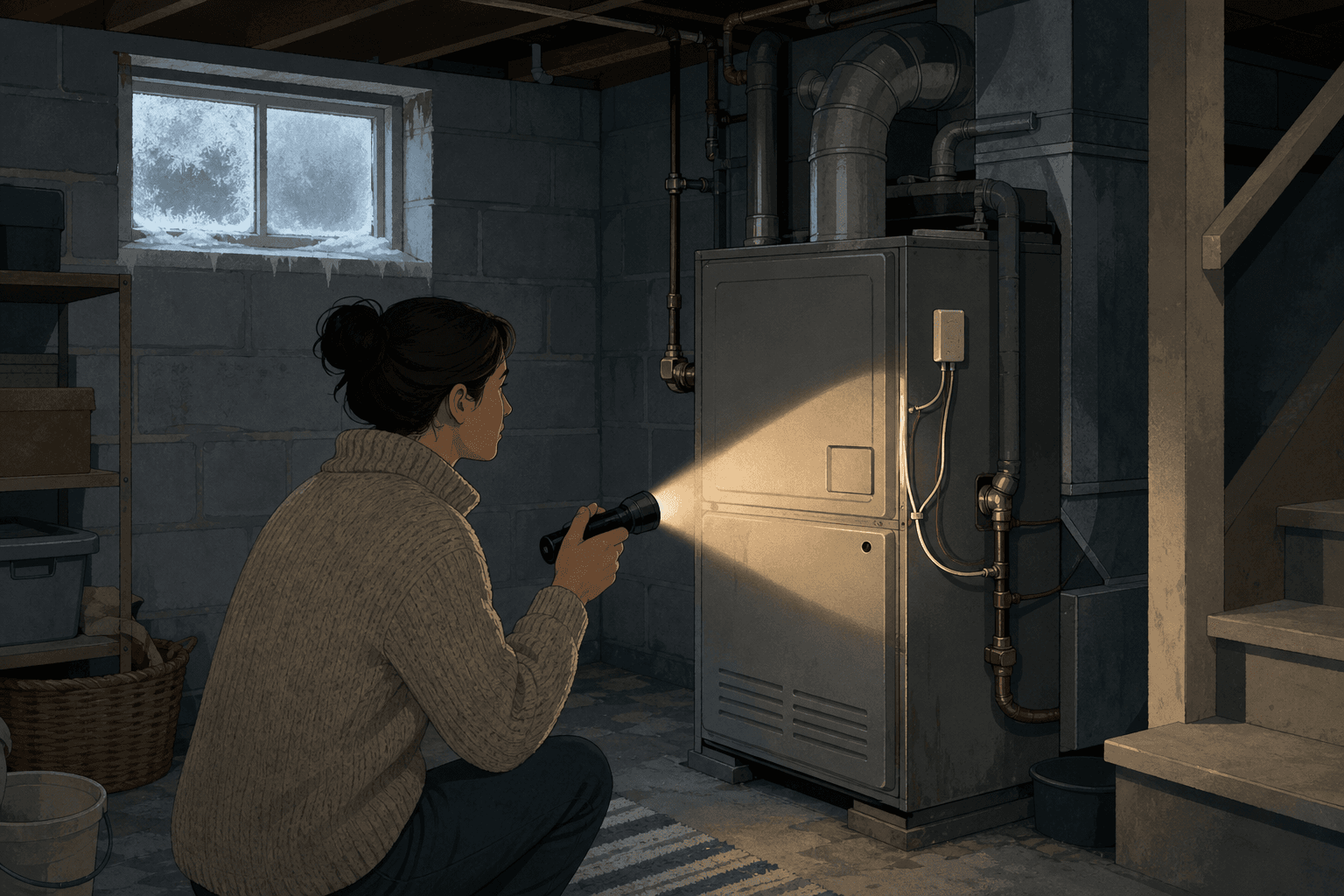
A furnace that will not start on a cold morning is usually one of a handful of things, and several of them a homeowner can check in ten minutes with no tools. This is the order a service technician works through on arrival, arranged so the cheap, safe checks come first. One rule sits above all of it: if you smell gas at any point, stop, leave the house, and call the gas utility from outside.
Key facts
- The thermostat, the power switch on the furnace, and a clogged filter are the first three things a technician checks, in that order.
- An oil burner's reset button is a one-press button. Pressing it again and again pushes unburned oil into the combustion chamber.
- A furnace that starts and shuts off within a minute or two is a diagnostic job, not a reset job.
- Many Clinton County homes, Mill Hall included, heat with oil. The tank gauge is a legitimate first check.
- A carbon monoxide alarm is not a troubleshooting step. Leave the house and call 911 or the utility.
Start at the thermostat
Confirm it is set to heat and the setpoint is above the room temperature. Then look at the display. A blank screen on a battery thermostat usually means dead batteries, and many wired thermostats still run on a pair of AAs. A blank screen on a smart thermostat that has no battery points at the furnace's low-voltage side: most control boards carry a small automotive-style fuse, and a blown one takes out the thermostat and the furnace together.
Check for a schedule or a hold. A programmable thermostat that dropped to a 58 degree night setting and never climbed back is a common no-heat call that ends in an apology.
Power to the furnace
There is a switch on or near the furnace that looks exactly like a light switch. It is often mounted on the side of the cabinet, sometimes at the top of the basement stairs, and on older systems it hides under a red cover plate marked emergency. Someone bumps it, or a painter flips it, and it stays off until the first cold night.
At the panel, look for a breaker labeled furnace or burner. Then check the blower door. Most furnaces have a safety switch behind the lower panel that cuts power when the door is off, and a panel that was pulled to change the filter and set back a half inch crooked will hold that switch open.
The filter
A packed filter starves the furnace of air. The heat exchanger overheats, a high limit switch trips to protect it, and the furnace shuts down. It cools, restarts, and does it again. That run, stop, run pattern is short cycling, and a filter is the first suspect.
Swap it. One inch filters need changing every one to three months through the heating season, and the arrow on the frame points toward the furnace. If the furnace runs normally after the change, that was the problem, but the repeated overheating is worth telling a technician about at the next service.
Oil furnaces: the tank, the reset, and the one-press rule
Check the tank gauge first. Float gauges stick, so tap the glass. Below about a quarter tank in cold weather the pickup can start pulling sludge from the bottom, which clogs the filter and the nozzle.
The reset button is on the primary control, the small box on the burner with a red or black button. Press it once. If the burner fires and stays lit, you are done for now. If it locks out again, stop. The cause is somewhere in fuel delivery or ignition: a clogged nozzle or filter, worn electrodes that no longer throw a strong spark, a pump problem, or a cad cell that cannot see the flame. Each extra press of the button sends another shot of oil into the chamber. When it finally lights, the puffback can crack the combustion chamber lining and coat the house in soot.
The oil filter at the tank is an annual service item. It is not a mid-outage homeowner fix unless you already know the bleed procedure for that burner.
Gas furnaces: watch the startup sequence
With no gas smell, the most useful thing you can do is watch the furnace try to start. Many units have a small sight window in the lower panel, and the control board shows a blinking status light with a legend printed on the door.
A gas furnace starts in a fixed order: the inducer fan spins up, a pressure switch proves the vent is clear, the igniter glows, the gas valve opens, the flame lights, and after a short delay the blower starts. Where the sequence stops tells you what failed.
- Nothing happens at all: power, thermostat, or the control board.
- The inducer runs but nothing follows: the pressure switch, or a blocked vent or condensate line.
- The igniter glows but no flame appears: gas supply or the gas valve.
- The flame lights and dies within a few seconds: a dirty flame sensor. This is a short cleaning job for a technician.
It runs, but the house stays cold
If the blower runs and the air from the registers is cool, the burner is not lighting, and the steps above apply. On high efficiency furnaces, look at the plastic condensate drain. In an unheated basement or garage that line can freeze or clog, and the furnace shuts itself down. Sidewall vent terminations outside can also plug with snow and ice in a heavy year.
If the air is warm but weak, look at the ductwork. Closed dampers, a crushed flexible duct, or a duct that pulled apart in a crawlspace will do it. In a mobile home, the crossover duct under a double-wide is the usual culprit, and a blocked return grille on the furnace closet door starves the whole system. There is more on that in the mobile home heating article on this site.
What a repair visit looks like
A technician confirms the failure before quoting anything. On gas furnaces the common parts are the igniter, the flame sensor, the pressure switch, and the control board. On oil, it is the nozzle, the filter, the electrodes, the cad cell, and the pump. Most of those are same-day repairs when the part is on the truck.
Age drives the repair or replace conversation more than the part does. A furnace in its second decade with a bad igniter is a repair. A furnace past twenty-five years with a cracked heat exchanger is a replacement conversation, because a cracked exchanger can push combustion gases into the house air. The furnace and HVAC repair service page describes how that visit runs, and the contractor checklist covers what to ask whoever shows up.
Common questions
How many times can I press the reset button on an oil furnace?
Once. If it locks out again, the burner needs service. A second press is where puffbacks start.
Is it safe to run the furnace with the panel off?
No. The blower door switch exists so the furnace cannot run with the panel off, and defeating it puts the fan and burner in reach. The filter compartment is the one place you can open without shutting anything down.
My furnace clicks but never starts. What is that?
On a gas furnace that is usually the ignition control trying and failing, or a relay on the board. On an oil furnace it is often the burner motor starting with no flame following, which lands you back at the one-press rule.
Should I keep running a furnace that short cycles?
Turn the thermostat down until someone looks at it. Every trip of the high limit is another heat cycle on the exchanger, and the cause, whether a filter, a fan, or a duct, is not going to fix itself.
If you have been through the list and the furnace is still off, note where in the sequence it stops. That one detail shortens the diagnosis more than anything else you can say on the phone. Request a visit here and include it.
Have a project like this in Lock Haven or Clinton County?